
YouTube Engagement Rate Calculator
Check a channel’s views-based engagement using public likes, comments and views from videos included in your selected window.
Calculating engagement
The YouTube Engagement Rate Calculator measures how frequently viewers interact with a channel’s public videos. Enter a YouTube @handle or channel URL, choose an upload window, and the tool calculates a views-based engagement rate using public likes, comments and views.
The result is useful for comparing public channel performance, but it is not an official YouTube metric or a replacement for YouTube Analytics. SanishTech uses its own clearly defined formula and the public information available for the videos included in the calculation.
What the YouTube Engagement Rate Calculator Measures
The calculator estimates the percentage of video views that resulted in a visible like or comment. It first identifies public videos associated with the selected upload window and then totals their current public statistics.
The result is calculated across the combined sample rather than averaging the percentage of every video. This prevents a low-view video from having the same weight as a video with millions of views.
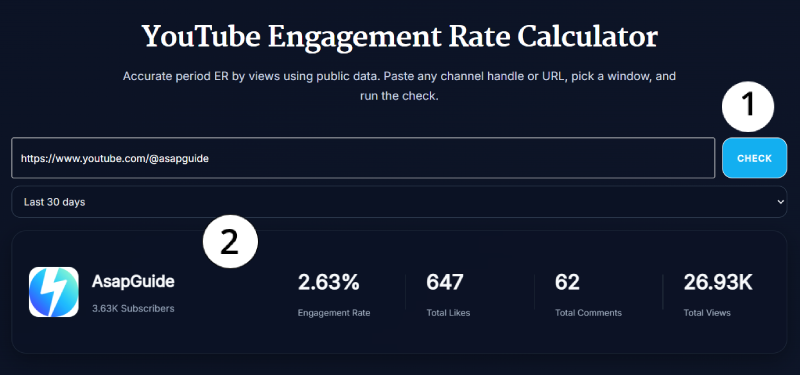
The calculator displays:
- The resolved channel name and profile image.
- The channel’s available public subscriber count.
- The number of public videos used in the sample.
- Total public likes for the included videos.
- Total public comments for the included videos.
- Total public views for the included videos.
- The calculated engagement rate by views.
YouTube Engagement Rate Formula Used by SanishTech
The YouTube Engagement Rate Calculator uses this formula:
Engagement rate = ((likes + comments + available shares) ÷ views) × 100
YouTube’s public API does not provide share totals to this tool. Shares are therefore set to zero, making the current effective formula:
Engagement rate = ((likes + comments) ÷ views) × 100
For example, imagine the included videos have 4,000 likes, 200 comments and 100,000 views:
((4,000 + 200) ÷ 100,000) × 100 = 4.20%
This means there were approximately 4.2 visible likes or comments for every 100 views in the selected sample. It does not mean 4.2% of unique viewers interacted because one viewer can watch more than once and the public data does not identify unique people.
How to Use the YouTube Engagement Rate Calculator
- Enter a channel: Paste a YouTube @handle or full channel URL into the input field.
- Select an upload window: Choose the last 30, 60, 90, 180 or 365 days, or select All time.
- Select Check: Wait while the tool resolves the channel and retrieves available public video statistics.
- Verify the channel: Confirm that the returned channel name and profile image match the creator you intended to check.
- Review the sample: Check the number of videos used, total likes, comments, views and calculated engagement rate.
How the Selected Time Window Works
The selected window determines which public uploads are included. For example, a 30-day calculation uses available videos associated with that recent upload window and totals their current public likes, comments and views.
This is not the same as asking how many likes or views the channel earned during the last 30 days. Public video statistics are cumulative, and they do not reveal exactly when each interaction happened. Channel owners can find period-specific private data inside YouTube Analytics.
The All time option uses up to 1,000 public videos. It may cover the complete upload history of a smaller channel, but it is a sample rather than a full lifetime calculation for channels with more than 1,000 public uploads.
Engagement Rate by Views vs Subscribers
There is no single universal YouTube engagement-rate formula. Calculators can produce different answers because they use different denominators and sampling methods.
- By views: Interactions are divided by video views. SanishTech uses this method.
- By subscribers: Interactions are divided by the channel’s subscriber count.
- Average by video: Each video’s rate is calculated before the results are averaged.
- Median method: Median interactions are divided by median views to reduce the effect of unusually viral videos.
Only compare percentages calculated with the same formula. A views-based result should not be compared directly with a subscriber-based result.
How to Interpret the Result
YouTube does not publish an official percentage that defines a good engagement rate. Channel size, niche, video format, upload frequency and the selected sample can all affect the number.
- Compare the channel with creators in a similar niche and size range.
- Use the same upload window and formula for every comparison.
- Compare Shorts-heavy channels with similar Shorts-heavy channels.
- Check whether one viral upload dominates the sample totals.
- Review multiple periods rather than judging a channel from one result.
YouTube’s public view-count definition also differs between Shorts and standard videos. According to the YouTube Data API documentation, a Shorts view can count when the Short starts or replays. Content-format differences should therefore be considered when comparing channels.
What This Engagement Rate Cannot Tell You
A percentage can add context, but it cannot prove that a channel has a loyal audience or guarantee campaign performance.
- It does not measure watch time, retention or average view duration.
- It does not include private reach or unique-viewer information.
- It cannot verify whether engagement came from a target audience.
- It cannot detect fake followers or manipulated engagement by itself.
- It does not predict rankings, recommendations, sponsorship results or revenue.
- It may exclude unavailable, private or deleted videos.
For a broader channel review, compare public channel data with the YouTube Channel Comparison. Channel owners can also use the YouTube CTR Calculator with their private impression and click data to examine discovery separately from interaction.
Frequently Asked Questions
How does the YouTube Engagement Rate Calculator work?
It resolves the supplied channel, selects public videos associated with the chosen upload window, totals their public likes, comments, and views, and calculates a views-based percentage. It also shows the channel, subscriber count, and number of videos used.
What formula does the calculator use?
SanishTech uses ((total likes + total comments + public shares) ÷ total views) × 100. YouTube’s public API does not provide share counts to this tool, so shares are currently set to zero. The effective calculation is therefore ((likes + comments) ÷ views) × 100.
What channel inputs and time windows are supported?
Enter a YouTube @handle or channel URL. Available windows are the last 30, 60, 90, 180, or 365 days, plus All time. Always confirm that the returned channel name matches the channel you intended to check.
Can I calculate engagement for a single YouTube video?
No. The current calculator is designed for channel handles and channel URLs. A video URL can resolve incorrectly and should not be used for a single-video engagement calculation.
What does All time mean in this calculator?
All time uses up to 1,000 sampled public videos. It may represent the full history of a smaller channel, but it is not a complete lifetime calculation for a channel with more than 1,000 public uploads.
Is the calculator free, and do I need an API key?
Yes. The calculator is free to use and does not require a SanishTech login or a user-supplied YouTube API key. It depends on public YouTube data being available.
What is a good engagement rate on YouTube?
YouTube does not publish one official good engagement-rate benchmark. Results vary by formula, channel size, niche, content format, and sample period. Compare channels using the same formula and similar content instead of applying one universal percentage.
What is the difference between engagement rate by views and subscribers?
Engagement rate by views divides interactions by views, while engagement rate by subscribers divides interactions by subscriber count. SanishTech uses views, so its result should only be compared with other views-based calculations.
Why can the result differ from YouTube Analytics?
This tool uses public totals for videos included in the selected upload window. YouTube Analytics can show private metrics and when engagement occurred. A 30-day selection here is therefore not the same as a creator’s complete 30-day Analytics report.
Does a higher engagement rate guarantee better monetization or rankings?
No. A higher rate can show that more visible viewers liked or commented, but it does not guarantee recommendations, rankings, sponsorship results, watch time, or revenue. Use it with retention, CTR, audience quality, and content context.