
Your Enterprise May Be More Human-Integrated Than System-Integrated
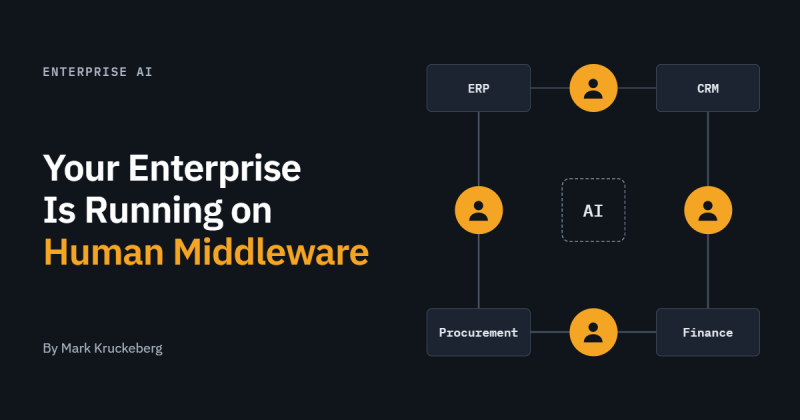
Enterprise architecture diagrams can create an impression of integration. ERP connects to CRM. Procurement connects to finance. Data moves between platforms. Workflows connect functions across the organization.
But those diagrams rarely show the people holding the connections together.
They don’t show the employee who knows which system to trust when two records disagree. The person who maintains a spreadsheet because two applications don’t reconcile. The manager who knows when the documented approval process doesn’t apply. Or the experienced employee everyone calls when a transaction doesn’t follow the expected path.
These employees aren’t simply performing tasks. They’re carrying context, business rules, exceptions, and institutional knowledge that the enterprise itself may never have formally captured.
They have become human middleware—the invisible integration layer between systems and processes that don’t always work together as seamlessly as the architecture suggests.
For years, that model could remain largely invisible because people compensated for the gaps. Work continued. Transactions were completed. Exceptions were resolved.
AI is beginning to make that dependency much harder to ignore.
As organizations look to AI to perform tasks, make recommendations, support decisions, and increasingly execute work with less human intervention, they may discover that the person they hoped to remove from a step wasn’t simply doing the work.
They were carrying operating logic the enterprise never formally encoded.
People Have Been Holding the Enterprise Together
Enterprise complexity rarely arrives all at once. It accumulates.
A new system is implemented. A business is acquired. A process is adapted for a particular customer or market. A local team develops a workaround. An exception becomes common enough that employees stop thinking of it as an exception.
Over time, the formal operating environment and the way work actually gets done can begin to diverge.
People bridge that gap.
They reconcile information between systems. They translate different definitions across functions. They remember which exceptions apply and when. They know who needs to be involved when the standard process isn’t enough. And when technology or process design leaves something unresolved, they find a way to keep the work moving.
That adaptability is one of the reasons enterprises continue to function despite enormous complexity. But it can also make the underlying complexity difficult to see.
There is an important distinction for executives to recognize. Some human involvement represents judgment—experience, expertise, accountability, and discretion that genuinely add value. Other involvement represents compensation—work people perform because systems, processes, data, or business rules don’t reliably provide what they need.
The two can look remarkably similar from the outside.
An employee reviewing a transaction may be exercising important judgment. Or they may simply be checking three systems because no one has established which one should be trusted. A manager approving an exception may be making a meaningful business decision. Or they may be compensating for a process that never incorporated a recurring business rule.
That distinction becomes increasingly important as organizations look for opportunities to automate work.
The problem isn’t that people are in the process. It’s when the process only works because people know how to work around it.
AI Exposes What Was Never Actually Encoded
For years, traditional automation could improve individual tasks while people remained between them—carrying information, resolving inconsistencies, interpreting exceptions, and supplying context as work moved across the enterprise.
AI changes the equation.
Organizations are increasingly asking AI not only to automate tasks, but to interpret information, make recommendations, support decisions, and coordinate work across processes and systems. As that happens, the knowledge employees have been supplying between those steps becomes much more important.
A system may contain a customer record. Another may contain the transaction history. A documented process may define the standard approval path. But none of them necessarily explains why an experienced employee knows that one source should be trusted over another, that a particular customer requires different treatment, or that an exception should be escalated before work continues.
Giving AI access to more systems does not automatically give it that understanding.
Recent Deloitte research illustrates the challenge. Only 5% of surveyed organizations considered their business processes highly prepared for AI agents, while just 15% had scaled orchestrated, cross-functional multi-agent adoption. Nearly two-thirds of executives surveyed were reevaluating their business models as they recognized that agentic AI requires changes to processes and workflows, not simply technology deployment.
The gap is not simply technological. It can also reflect how much of the enterprise’s operating logic has never been formally captured in its systems, processes, data, or business rules.
Over time, undocumented exceptions, manual reconciliations, inconsistent processes, disconnected systems, and institutional knowledge accumulate. Employees learn to absorb that complexity and keep the enterprise functioning.
That creates a form of operational debt that can remain hidden as long as experienced people continue carrying it.
AI doesn’t create that operational debt. It exposes where people have been carrying it.
Don’t Automate Away What You Don’t Understand
The obvious response to human middleware is to eliminate it.
If employees are manually moving information between systems, reconciling data, navigating exceptions, or coordinating work across functions, AI and automation appear to offer a better alternative.
In many cases, they will.
But removing human intervention before understanding why it exists can create a different problem. The visible task may be manual, while the value being provided by the employee is largely invisible.
Before automating that work, organizations need to understand what the person is actually doing.
If an employee is entering information that should already flow between systems, eliminate the unnecessary work. If they are reconciling competing definitions, establish which definition should govern. If they are navigating process variation that serves no business purpose, simplify it. If they are applying a legitimate but undocumented business rule, capture it.
And if they are exercising judgment that genuinely requires experience, accountability, or discretion, preserve the human role.
That distinction matters. In Deloitte’s recent research, 75% of surveyed leaders agreed that human collaboration with AI agents creates more value than AI-agent-powered automation alone. The opportunity, therefore, isn’t simply to remove people from processes. It is to determine where human involvement adds value and where people have been compensating for operating conditions that should be improved.
The two require very different responses.
The objective isn’t to eliminate human involvement. It’s to eliminate unnecessary dependence on humans to compensate for an operating environment that doesn’t work without them.
Make the Invisible Operating Model Visible
Before deciding where AI should remove manual work, leaders need to understand where people are acting as the connective tissue of the enterprise.
That requires looking beyond documented processes and system architecture to how work actually gets done.
Where do employees routinely reconcile information between systems? Where does critical context live outside formal processes? Where do people know which data to trust when systems disagree? Which exceptions depend on institutional memory? Where does work slow down—or stop—when a particular experienced employee isn’t available? Where have spreadsheets, email, or offline conversations become unofficial parts of the workflow?
These aren’t simply opportunities to automate. They are clues to where the enterprise may depend on operating knowledge that has never been formally captured.
Making those dependencies visible allows leaders to decide what should happen next. Some work can be eliminated. Some processes should be simplified. Business rules may need to be clarified and governed. Systems and data may need to be better connected. Institutional knowledge may need to be captured. And some decisions should intentionally remain with people.
For some organizations, this means taking a more integrated approach to how people, processes, systems, governance, and data work together—an operating discipline often described as enterprise operational orchestration.
AI creates an opportunity to rethink that operating environment. But organizations shouldn’t confuse human involvement with inefficiency—or assume that technology can replace context the enterprise itself has never captured.
Some employees are providing valuable judgment. Others are compensating for fragmentation. Often, they are doing both.
Before removing the human from the loop, understand what the human has been holding together.