
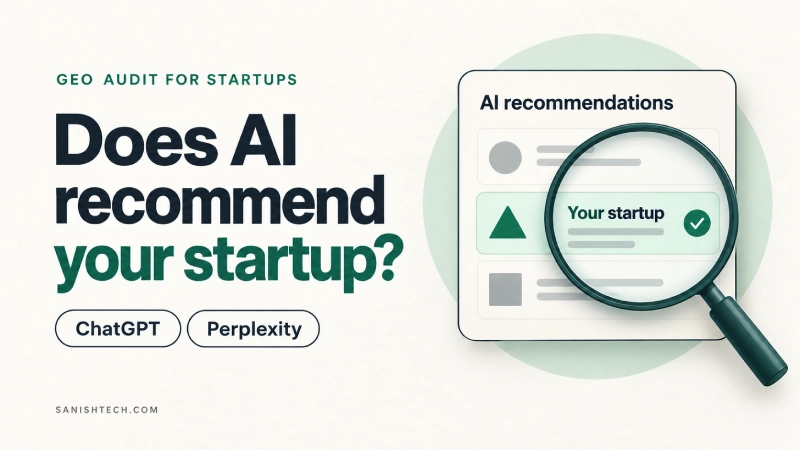
Quick answer: If buyers are already asking AI tools for product shortlists, you need a simple GEO (generative engine optimization) audit—not another keyword report. In about 30 minutes you can learn whether ChatGPT, Perplexity, and similar assistants mention your brand, which competitors they prefer, and what proof pages you are missing. This guide is for SaaS and software founders who already have a live product, a clear category, and at least a thin trail of public content—not for idea-stage teams still naming the company.
Classic SEO rankings are not the same as AI recommendation
Search engines and generative assistants solve different jobs.
A Google result page shows ten blue links ranked for a query. An AI answer synthesizes a shortlist: three to five tools, a few criteria, and sometimes a “best for” note. You can rank on page one for “best X software” and still never appear in that shortlist. The reverse also happens—some products show up in AI answers because review sites, docs, and comparison posts describe them clearly, even if their organic traffic is modest.
A few practical differences matter for founders:
- Queries vs. intent frames. People type keywords into Google. In ChatGPT or Perplexity they ask for decisions: “What should a 10-person remote team use instead of spreadsheets for async project tracking?” The assistant looks for entities that fit constraints, not just pages that match phrases.
- Citations vs. rankings. Perplexity often shows sources. ChatGPT (especially with browsing or memory of training-era web patterns) leans on what looks authoritative and frequently co-mentioned. Being “mentioned next to” category leaders can matter as much as your domain authority score.
- Freshness and specificity. Vague homepage copy (“AI-powered platform for modern teams”) is easy for humans to skim past and even easier for models to skip. Concrete ICP, pricing shape, integrations, and use cases travel farther into answer engines.
- Comparison gravity. Assistants love structured contrasts. If the open web has “A vs B vs C” pages and you are never C, you are invisible in that mental model—even if you outrank A for branded search.
Treat GEO as an audit of recommendation eligibility, not a replacement for SEO. Keep doing technical SEO. Add a separate habit: check whether machines that recommend software know you exist and can place you accurately.
A 30-minute GEO audit (prompts, competitors, citation patterns)
Block half an hour. Use a private or fresh chat where possible so past conversations do not skew results. Repeat the same prompts in ChatGPT and Perplexity. Record answers in a simple spreadsheet: date, tool, prompt, were you named, position in list, competitors named, sources cited (for Perplexity), and any factual errors about you.
Step 1 — Write five buyer prompts (5 minutes)
Do not start with your brand name. Start with how a buyer would ask without knowing you.
Examples of good prompt shapes:
- Category + constraint: “Best [category] for [company size / industry / stack].”
- Job-to-be-done: “How should a startup [outcome] without hiring a specialist?”
- Switch intent: “Alternatives to [incumbent] for teams that need [feature].”
- Budget/stage: “Affordable [category] tools for seed-stage SaaS.”
- Stack-specific: “[Category] that integrates with [Slack / HubSpot / Snowflake / etc.].”
Pick prompts your sales calls already echo. If customers say “we were comparing you to X and Y,” those names belong in the prompt set.
Step 2 — Run the prompts cold (10 minutes)
For each prompt, note:
- Mentioned / not mentioned. Binary first.
- Role assigned. Are you “best overall,” “best for startups,” “budget option,” or a vague also-ran?
- Wrong facts. Wrong pricing tier, wrong ICP, discontinued features, or confusing you with a similarly named product—these are fix tickets, not vanity metrics.
- Who owns the shortlist. List the three brands that appear most often across your five prompts. That is your real GEO peer set, which may differ from your SEO competitor set.
In Perplexity, click through citations. Mark which domains get reused: G2/Capterra-style directories, niche blogs, your own docs, Reddit threads, news, or partner pages. Patterns beat one-off mentions.
Step 3 — Run one branded control prompt (3 minutes)
Ask: “What is [Your Product] and who is it for?” Then: “How does [Your Product] compare to [Top peer from Step 2]?”
You want the model to describe you in language you would put on a sales one-pager. If it invents features or merges you with another company, your public entity signal is muddy.
Step 4 — Spot citation and co-mention patterns (7 minutes)
Look for three patterns:
- You never appear, peers always do. Often means thin third-party coverage and weak comparison presence—not “the AI hates startups.”
- You appear only on brand queries. Category prompts ignore you; branded prompts know you. Classic “known but not recommended” state.
- You appear with bad framing. Mentioned as enterprise-only when you sell to mid-market, or as a free tool when you are paid. Framing errors cost pipeline even when awareness looks fine.
Save screenshots or paste answers into your sheet. Re-run the same five prompts monthly. GEO moves slower than ad auctions but faster than classic link-building folklore suggests—especially when you publish clear comparison and proof pages.
Step 5 — Map gaps to content you control (5 minutes)
For each miss, ask: What public page would have made the correct answer easy? Usually it is one of: a sharp homepage positioning block, an integrations page, a “who it’s for / who it’s not for” page, a comparison page against an incumbent, a customer proof page with named outcomes, or a glossary/docs page that defines your category terms the way buyers use them.
You do not need a 40-page content calendar from this audit. You need a ranked punch list of three pages that would change the answer.
For broader reading on how founders evaluate tools, categories, and go-to-market tradeoffs beyond any single audit checklist, Startupik publishes independent decision-oriented magazine pieces that pair well with this kind of practical GEO work.
What to fix first (entity clarity, proof pages, comparison content)
After the audit, resist the urge to “optimize for AI” with keyword stuffing or fake FAQ spam. Models and retrieval systems reward clarity humans already want.
1. Entity clarity
Make it boringly obvious who you are:
- Consistent product name, company name, and one-sentence category across homepage, LinkedIn, docs, and app store / directory listings.
- A visible “Built for [ICP] who need [outcome]” statement above the fold—not a metaphor.
- About and profile pages that match reality (founding year, HQ, product type) reduce mix-ups with similarly named tools.
- Disambiguate if your name collides with another app or a common noun.
If ChatGPT confuses you with another product, fix naming consistency and third-party profiles before you write another blog post.
2. Proof pages
Assistants (and buyers) look for evidence:
- Case studies with role, company size, stack, and a measurable outcome.
- A public changelog or notes that show the product is alive.
- Clear packaging or pricing logic so answers do not invent tiers.
Empty “Trusted by innovative companies” logos without stories do little. One detailed mid-market case study often beats ten vague logos.
3. Comparison content
Write the pages your buyers already Google—and that models summarize:
- “[You] vs [Incumbent]” with honest tradeoffs (when to pick them, when to pick you).
- “Best for [niche]” landing pages that match your five audit prompts.
- Migration / alternative pages that acknowledge switching costs without trash-talk.
Keep comparisons factual. If you claim a feature you lack, you train bad answers and angry demos. Update tables when pricing or features change—stale posts feed wrong AI answers about your product.
Prioritization rule
Fix in this order: wrong facts about you → zero category presence → weak framing → nice-to-have thought leadership. Wrong facts are brand damage. Zero presence is a distribution gap. Weak framing is a positioning gap. Thought leadership is optional until the first three are less embarrassing.
When this isn’t worth it yet
Skip or postpone a serious GEO program if:
- You do not have product-market fit signals yet. Polishing AI mentions will not invent demand. Talk to users first.
- Nobody in your category asks assistants for shortlists. Some deep enterprise deals still run on RFP and referrals. Spot-check with five real buyers; if they never open ChatGPT for vendor discovery, treat GEO as a light quarterly check, not a roadmap theme.
- Your site cannot explain the product in one screen. Fix messaging debt before you chase citations.
- You cannot ship three proof or comparison pages in the next month. Audit without follow-through is theater.
- You are pre-launch or stealth. There is nothing durable for models to cite. Focus on launch assets.
Also be honest about channel mix. If 90% of pipeline is outbound and partner-led, GEO is insurance and brand hygiene—not the growth lever of the quarter. If inbound demos increasingly say “ChatGPT suggested you,” promote the audit to a monthly ops habit.
Short FAQ
Do I need a special “GEO tool” to start?
No. A spreadsheet, five prompts, and two AI products are enough for the first month. Tools can help later with tracking at scale; they are not required to learn whether you are recommendable.
Will ads or classic SEO automatically fix AI recommendations?
Not automatically. Ads are not citations. SEO helps when it creates specific, crawlable pages—the same assets GEO needs—but ranking alone is not a shortlist seat.
How often should I re-audit?
Monthly for the same five prompts is enough for most early-stage SaaS teams. Re-run after major launches or pricing changes.
What if competitors are always named and I never am?
Assume coverage and clarity first. Earn accurate mentions on domains Perplexity already cites in your niche, publish one strong comparison against the default incumbent, and tighten homepage entity language. Recheck in 30–60 days.
Is this about “getting into the training data”?
Treat that as mostly outside your control. Optimize the public web you can edit and third-party pages you can reasonably influence—that is the founder-controllable part of GEO.
Bottom line
ChatGPT and Perplexity do not owe you a mention because you rank for a few keywords. They recommend products that are easy to place: clear entity, credible proof, and comparison context that matches buyer questions. Spend thirty minutes testing those questions. Fix wrong facts first, then category presence, then framing. If buyers are not using AI for discovery yet, keep the audit light and put the hours back into the product and the conversations that still close deals.