
Let’s be real for a second: the relationship between creators and AI has become a bit of a “cat and mouse” game. On one hand, tools like ChatGPT and Claude have revolutionized how we brainstorm, draft, and structure content. On the other hand, we’ve seen the rapid rise of AI detectors—those digital gatekeepers like Turnitin, GPTZero, and Originality.ai—that are designed to sniff out anything that smells like a machine wrote it.
Whether you are a student trying to ensure your research paper doesn’t get flagged by a “false positive” or a content creator worried about Google’s stance on AI-generated spam, the struggle is the same. You need your content to sound human. You need it to have soul, rhythm, and—most importantly—you need it to be undetectable.
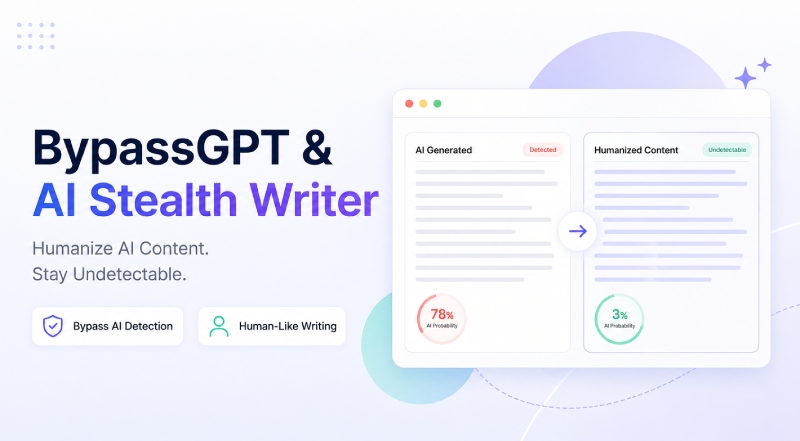
This is where specialized tools like BypassGPT and AI Stealth Writer come into play. They aren’t just “spinners”; they are sophisticated humanizers. In this guide, we’re going to dive deep into how these tools work and how you can use them to stay ahead of the detection curve.
The Great AI Arms Race: Detection vs. Creation
Why is everyone suddenly obsessed with “bypassing” AI detection? It’s not necessarily about “cheating” the system. It’s about the fact that AI detectors are notoriously finicky. They look for patterns—low perplexity (predictable word choice) and low burstiness (uniform sentence length).
If you write a very clear, structured, and logical piece of content, an AI detector might flag it as “AI-generated” simply because it’s too perfect. For students, a false positive can be a nightmare for their academic reputation. For SEO professionals, AI-heavy content can sometimes fail to meet Google’s “E-E-A-T” (Experience, Expertise, Authoritativeness, and Trustworthiness) standards.
To bridge this gap, we need a way to inject “human noise” back into the text.
Meet the Game Changers: BypassGPT and AI Stealth Writer
If you’ve ever tried to manually rewrite an AI draft to pass detection, you know it’s a soul-crushing task. It takes almost as much time as writing from scratch. That’s why specialized humanizers have become the “secret sauce” for modern workflows.
What Exactly is BypassGPT?
BypassGPT is arguably one of the most powerful tools in the “undisclosed writing” niche. Unlike basic paraphrasers that just swap synonyms (which detectors catch easily), BypassGPT uses advanced modeling to restructure sentences entirely.
It analyzes how humans actually write—with our weird idioms, varied sentence structures, and occasional stylistic flourishes. When you run a piece of text through BypassGPT, it essentially “translates” the robotic output into something that feels organic. The best part? It’s specifically calibrated to beat the heavy hitters like GPTZero and Winston AI.
The Precision of AI Stealth Writer
While BypassGPT is great for broad humanization, an AI Stealth Writer often acts as a more surgical tool. These tools focus on maintaining the intent and the technical accuracy of the writing while stripping away the digital fingerprints.
For content creators, an AI Stealth Writer is a godsend for maintaining a specific brand voice. You don’t want your blog post to sound like a generic robot, but you also don’t want it to sound like a different person wrote every paragraph. These tools help maintain a consistent, human-like flow across long-form content.
Why Students are Turning to Humanizers
The academic world is currently in a state of flux. Professors are using detectors more than ever, yet the line between “using AI as a research assistant” and “letting AI write your paper” is incredibly blurry.
Avoiding the “False Positive” Trap
Many students use AI to help outline or simplify complex topics. However, even if a student writes 80% of the paper themselves, the remaining 20% of AI-assisted polishing can trigger a flag. By using BypassGPT, students can ensure that their final draft reflects a human touch, protecting them from aggressive algorithms that might otherwise penalize honest work.
Enhancing Readability
AI-generated academic content is often dry and repetitive. Using an AI Stealth Writer allows students to take a dense, AI-summarized technical concept and turn it into something a human professor would actually enjoy reading. It adds the “burstiness” (variation in sentence length) that makes academic writing feel more authoritative and less like a database dump.
Content Creators: The SEO and Brand Safety Angle
If you’re a professional blogger or a niche site owner, the stakes are even higher. Google has stated that it rewards high-quality content regardless of how it’s produced, but there’s a catch: it must be for humans and helpful.
Navigating Google’s E-E-A-T
Pure AI content often lacks the “Experience” and “Expertise” markers. It feels hollow. By running your drafts through BypassGPT, you’re not just hiding from detectors; you’re actually making the content better for your readers. You’re breaking up those monotonous “ChatGPT-style” paragraphs into engaging, conversational prose.
Scalability Without the Risk
The dream for every creator is to produce 10x more content without sacrificing quality. Tools like AI Stealth Writer allow you to scale your production. You can use AI to generate the bulk of the information and then use the stealth writer to “finish” the piece, ensuring it’s ready for prime time and won’t be suppressed by search engine updates that target low-effort AI spam.
How to Humanize Your Content: A Step-by-Step Strategy
Simply clicking “Humanize” isn’t always enough if you want the best results. Here is the professional workflow for using tools like BypassGPT effectively:
- The Hybrid Draft: Don’t just ask ChatGPT for a “1200-word article.” Ask it for an outline, then ask it to write section by section. This creates more natural variance from the start.
- The Stealth Pass: Input your AI-generated sections into AI Stealth Writer. Choose the “Human” or “Creative” mode to ensure the syntax is sufficiently randomized.
- The Bypass Check: Take that output and run it through BypassGPT for a final polish. This is the stage where the tool ensures that the “probability patterns” of the words are indistinguishable from human writing.
- The 10% Manual Rule: Always spend 5–10 minutes reading the final output. Add one personal anecdote, one specific local reference, or one unique opinion. This “manual injection” makes the content 100% bulletproof.
The Ethics of Undetectable AI Writing
Is it “wrong” to use BypassGPT or AI Stealth Writer? Context is everything.
If you are using these tools to spread misinformation or bypass legitimate learning requirements, you’re on shaky ground. However, if you are using them as a refinement tool—to clear up clunky AI phrasing, to avoid unfair detection, or to make your professional content more engaging—then you are simply using the best technology available to do your job better.
In the modern digital landscape, these tools are becoming as essential as spellcheck or Grammarly. They are the final layer of editing in an AI-integrated world.
Looking Ahead: The Future of the “Invisible” Writer
As AI detectors get smarter, humanizers like BypassGPT will continue to evolve. We are moving toward a future where “AI-generated” won’t be a dirty word, but “low-quality” will always be a problem.
The winners of the next few years won’t be the people who refuse to use AI. They will be the people who know how to use AI so effectively that you can’t even tell it was there. By leveraging the power of AI Stealth Writer and BypassGPT, you’re not just bypassing a filter; you’re mastering a new form of digital craftsmanship.
Final Thoughts for Success
- For Students: Use these tools to polish your thoughts, not replace them.
- For Creators: Focus on the value you provide the reader, using stealth tools to ensure your message isn’t blocked by technical hurdles.
For Everyone: Stay curious. The tools are changing every week, and staying ahead of the curve is the only way to remain relevant.