

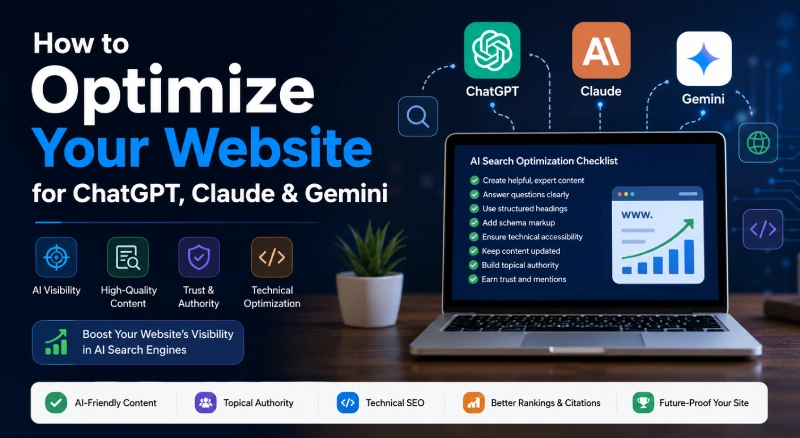
To optimize your website for ChatGPT, Claude, and Gemini, create authoritative content with clear answers, strong topical coverage, structured headings, trustworthy sources, and technical accessibility. AI search engines favor websites that are accurate, easy to understand, well-organized, and consistently updated rather than pages that simply target keywords.
Why AI Search Requires a Different SEO Mindset
Ranking on Google is no longer the only goal.
Millions of users now ask AI assistants instead of typing traditional search queries. If your content isn’t easy for AI models to understand and trust, it has fewer opportunities to be referenced in generated answers.
Traditional SEO helps users find your page. AI optimization helps AI confidently cite your information.
How ChatGPT, Claude, and Gemini Discover Content
AI assistants don’t all work the same way.
Some rely on live web search for certain queries, while others combine pretrained knowledge with fresh information from trusted sources and search indexes.
Although their retrieval methods differ, they share several priorities:
- High-quality content
- Trustworthy sources
- Clear page structure
- Updated information
- Strong topical authority
AI systems are designed to reduce uncertainty before presenting information as an answer.
The Core Ranking Signals AI Search Engines Prefer
The strongest AI-friendly websites consistently demonstrate expertise rather than simply publishing large amounts of content.
Focus on these signals.
Clear Topical Authority
Cover one subject deeply instead of publishing isolated articles.
For example, a website about SEO should naturally include content on:
- Technical SEO
- Schema markup
- AI search optimization
- Core Web Vitals
- Content strategy
- Internal linking
Closely related articles reinforce expertise across the topic.
Topical authority is built through depth, not volume.
Direct Answers
Answer important questions immediately.
Instead of writing lengthy introductions, begin sections with concise explanations.
Example:
Question: How do AI search engines evaluate websites?
Answer: AI search engines evaluate websites using signals such as content quality, authority, freshness, structure, citations, and overall trustworthiness.
That single paragraph can be extracted as a featured answer.
Clear answers improve both human readability and AI comprehension.
Structured Headings
Organize every page logically.
A strong structure looks like this:
- H1
- H2
- H3 where needed
- Bullet lists
- Comparison tables
- FAQs
Well-structured content is easier for both users and AI models to interpret.
Build Content AI Can Understand and Cite
The goal isn’t to write for machines.
It’s to remove unnecessary complexity so both humans and AI can understand your content quickly.
Practical techniques include:
- One main idea per paragraph
- Descriptive headings
- Short explanatory lists
- Accurate terminology
- Consistent formatting
Content with a clear structure is more likely to be cited accurately.
Add Reliable Sources
AI systems favor information supported by credible references.
When discussing technical topics, link to official documentation where appropriate.
For example, Google’s guidance on creating helpful content provides valuable insight into quality expectations:
https://developers.google.com/search/docs/fundamentals/creating-helpful-content
Similarly, OpenAI explains how its web crawler works and how publishers can manage access:
https://platform.openai.com/docs/gptbot
Use external references to strengthen factual claims, not to inflate link counts.
Reliable citations improve perceived trustworthiness.
Write Standalone Sections
Each important paragraph should make sense on its own.
Avoid phrases like:
- As mentioned earlier
- In this article
- Above we discussed
Instead, write complete thoughts that retain meaning even when quoted independently.
This improves extractability for AI-generated answers.
Technical Changes That Improve AI Visibility
Good content remains the foundation, but technical accessibility matters.
Improve Crawlability
Search engines and AI crawlers need consistent access to your pages.
Review:
- robots.txt
- XML sitemap
- Internal linking
- Canonical tags
- Broken links
Pages that are difficult to crawl are less likely to become trusted references.
Use Structured Data
Schema markup helps search engines interpret page content more accurately.
Useful schema types include:
- Article
- FAQ
- Organization
- Breadcrumb
- Product
- Review
Structured data doesn’t guarantee AI citations, but it improves machine readability.
Schema provides context that plain HTML cannot.
Keep Information Fresh
AI systems increasingly value current information.
Regularly update:
- Statistics
- Screenshots
- Pricing
- Product comparisons
- Industry changes
Fresh content signals active expertise.
Should You Allow AI Crawlers?
For most public websites, allowing reputable AI crawlers makes sense.
Services such as GPTBot and Google-Extended respect publisher preferences when configured correctly.
If your business depends on proprietary research, premium reports, or restricted content, limiting AI crawler access may be appropriate.
For blogs, educational websites, SaaS companies, and publishers seeking visibility, allowing access generally increases the opportunity for AI systems to understand and reference public content.
AI visibility begins with accessibility.
Measuring Success Beyond Traditional Rankings
Success in AI search isn’t measured only by keyword positions.
Monitor additional signals such as:
- Referral traffic from AI platforms
- Brand mentions
- Citation frequency
- Growth in direct searches
- Increased branded queries
- User engagement
- Returning visitors
As AI search evolves, visibility will become broader than search engine rankings alone.
Advanced Strategies to Increase Visibility in AI Search
Basic optimization gets your pages indexed. Advanced optimization increases the chances of your content being cited.
Build Topic Clusters Instead of Standalone Articles
AI models trust websites that cover a topic comprehensively.
Instead of publishing one article about AI SEO, create a network of related content:
- What is AEO?
- GEO vs SEO
- AI Search Ranking Factors
- LLMs.txt Guide
- GPTBot Explained
- How AI Crawlers Work
- Schema for AI Search
Internal links help AI understand topical relationships.
A website with strong topical depth is more likely to become a trusted reference.
Write for Questions, Not Just Keywords
AI search starts with questions.
Instead of targeting only:
AI Search Optimization
Also answer:
- How do AI search engines work?
- Can ChatGPT crawl websites?
- Does Gemini use structured data?
- How can my website appear in AI answers?
Question-driven content aligns naturally with conversational search.
Create Original Insights
AI systems often cite content that contributes something unique.
Examples include:
- Original frameworks
- Checklists
- Comparison tables
- Research
- Screenshots
- Real-world examples
Unique information is harder for AI to replace with generic summaries.
SEO vs AEO vs GEO
These terms are closely related but serve different goals.
| SEO | AEO | GEO |
|---|---|---|
| Optimizes for search rankings | Optimizes for direct answers | Optimizes for generative AI platforms |
| Focuses on clicks | Focuses on citations | Focuses on AI visibility |
| Google and Bing | AI assistants | ChatGPT, Claude, Gemini, Perplexity |
| Keywords matter most | Questions matter most | Context and authority matter most |
SEO drives discovery.
AEO improves answer extraction.
GEO expands visibility across generative AI systems.
Answer Engine Optimization (AEO) is the practice of structuring content so AI assistants can easily extract and present accurate answers.
Real Example: Optimizing a Blog Post for AI Search
Suppose you publish an article titled:
Best AI Writing Tools
Instead of listing tools immediately, structure it like this:
Step 1
Open with a direct answer that defines AI writing tools.
Step 2
Use question-based headings such as:
- Which AI writing tool is best?
- Are free AI writing tools worth using?
- Which AI tool is best for SEO?
Step 3
Add comparison tables.
Step 4
Support factual claims with authoritative sources.
Step 5
Use FAQ schema.
Step 6
Link to related articles on your site.
The result is content that’s easier for users to read and easier for AI to understand.
Common Mistakes That Reduce AI Visibility
Writing Only for Keywords
Keyword stuffing no longer creates authority.
Comprehensive answers perform better than repeating the same phrase.
Publishing Thin Articles
AI systems favor pages that solve a topic completely.
A 500-word article that barely scratches the surface is less useful than a detailed resource with practical guidance.
Ignoring Internal Links
Internal links help AI understand the relationship between your content.
Strong topic clusters improve contextual understanding.
Outdated Information
AI prefers current and accurate information.
Review older content regularly and update:
- Statistics
- Product features
- Screenshots
- Industry changes
Freshness strengthens trust.
Weak EEAT Signals
Show who created the content.
Include:
- Author information
- References
- Company details
- Editorial policies
- Updated dates
Trust signals matter for both users and AI.
Recommended Tools for AI Search Optimization
Keyword Research
- Ahrefs
- Semrush
- Google Search Console
Technical SEO
- Screaming Frog
- Sitebulb
- Google PageSpeed Insights
Content Optimization
- Surfer SEO
- Clearscope
- Frase
Structured Data
- Google’s Rich Results Test
- Schema Markup Validator
AI Monitoring
- Profound
- Peec AI
- Goodie AI
Using tools is helpful, but strategy matters more than software.
The Future of AI Search
AI search is moving toward trusted sources instead of simply matching keywords.
Expect to see:
- More conversational search
- Personalized AI answers
- Greater emphasis on expertise
- Better source attribution
- More citations to authoritative websites
The websites that consistently publish accurate, well-structured, and trustworthy content will have a lasting advantage.
Generative Engine Optimization (GEO) is the practice of improving a website’s visibility across AI-powered search platforms that generate answers instead of displaying only links.
Topical authority is built by publishing comprehensive, interconnected content that thoroughly covers a subject.
Frequently Asked Questions
How do I get my website into ChatGPT?
Publish high-quality, publicly accessible content, maintain strong technical SEO, allow appropriate AI crawlers where it fits your strategy, and build topical authority. ChatGPT may reference content through live search integrations or trusted indexed sources depending on the query.
Does traditional SEO still matter?
Yes. Technical SEO, content quality, crawlability, and backlinks remain essential. AI optimization builds on traditional SEO rather than replacing it.
Does schema markup improve AI visibility?
Schema helps search engines and AI systems understand page context more accurately. While it doesn’t guarantee citations, it improves machine readability and supports better content interpretation.
Should I create an llms.txt file?
If you want to define how supporting AI crawlers interact with your content, an llms.txt file can be useful. It complements, rather than replaces, robots.txt.
How often should I update AI-focused content?
Review important articles every three to six months, or sooner if there are major changes to AI platforms, search behavior, or industry guidance.
Which is more important: backlinks or topical authority?
Both matter. Backlinks build external trust, while topical authority demonstrates deep expertise. The strongest websites invest in both.
Can small websites appear in AI answers?
Yes. AI systems often prioritize relevance, clarity, and authority over brand size. A well-written niche article can outperform a larger site if it answers a specific question more effectively.