
A few years ago, artificial intelligence felt like something distant. Something reserved for tech giants, research labs, or sci-fi movies. Most people didn’t expect to interact with it directly.
Fast forward to today, and it’s quietly woven into everyday life.
You ask your phone for directions. It responds instantly.
You type a message, and words appear before you finish thinking.
You open a streaming app, and it already knows what you might like.
That’s artificial intelligence at work.
And this shift brings up a simple but important question:
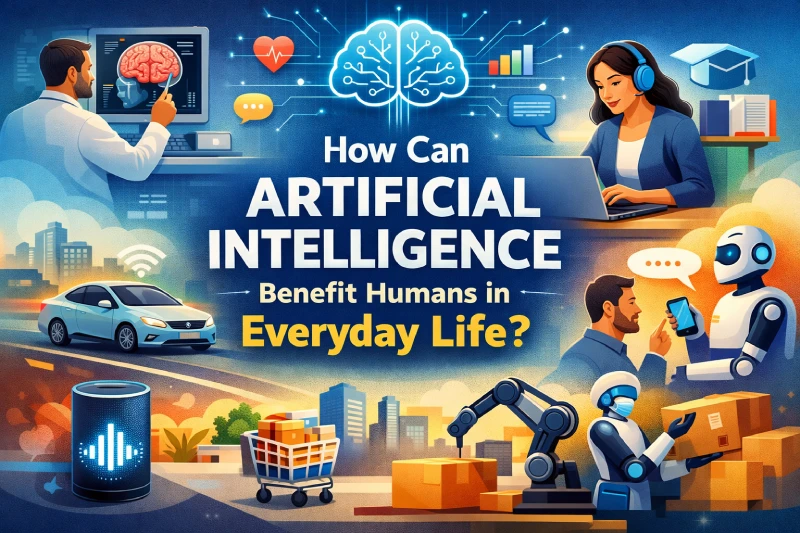
How can artificial intelligence benefit humans in real life?
Not in theory. Not in the future. Right now.
Let’s break it down in a way that actually connects with daily experience.
What Is Artificial Intelligence in Simple Terms?
Artificial intelligence, often called AI, refers to machines or software that can learn, think, and make decisions in ways that mimic human intelligence.
Instead of just following fixed instructions, AI systems:
- analyze data
- recognize patterns
- improve over time
- make predictions
Here’s a simple way to look at it.
A normal program follows rules you give it.
AI learns those rules by observing data.
For example:
- A regular calculator gives exact answers based on input
- An AI system can suggest what you should calculate next
That learning ability is what makes AI powerful.
Why Artificial Intelligence Matters More Than Ever
AI isn’t new. It has existed for decades.
What changed recently is accessibility.
AI is now:
- faster
- cheaper
- available to everyone
You don’t need to be a developer or scientist to use it.
If you:
- search on Google
- use voice assistants
- shop online
- scroll social media
You are already interacting with AI.
And the reason it matters so much now is simple.
It reduces effort while increasing output.
That combination is what makes it so impactful.
How Can Artificial Intelligence Benefit Humans?
Now let’s get into the real value.
Artificial intelligence benefits humans in ways that are both obvious and subtle. Some are visible daily, others work quietly in the background.
Let’s explore them one by one.
1. AI Saves Time on Repetitive Tasks
Time is one of the most valuable resources we have.
AI helps reclaim it.
Think about tasks that feel repetitive:
- writing similar emails
- organizing files
- entering data
- summarizing long content
AI tools can handle these in seconds.
A small example.
You receive a long report. Instead of reading everything, AI can summarize it into key points. What used to take 30 minutes now takes 30 seconds.
That doesn’t just save time.
It changes how you work.
2. AI Improves Healthcare and Saves Lives
This is one of the most impactful areas.
Healthcare used to rely heavily on manual analysis. Now AI adds another layer of intelligence.
Here’s how it helps:
- detecting diseases earlier
- analyzing medical scans faster
- predicting health risks
- assisting doctors in diagnosis
Imagine a doctor reviewing hundreds of scans daily. AI can highlight potential issues instantly, allowing the doctor to focus on critical decisions.
Another real-world scenario.
Wearable devices track heart rate, sleep, and activity. AI analyzes this data and alerts users about possible health concerns.
That’s proactive healthcare.
According to research from the World Health Organization, artificial intelligence is increasingly being used to support early diagnosis and improve patient outcomes in healthcare systems.
3. AI Makes Learning Easier and More Personalized
Education used to follow a fixed structure.
Same lessons. Same pace. Same method.
But people don’t learn the same way. That is also why more learners and professionals are exploring structured options like an iit ai course to build practical AI knowledge at their own pace.
AI changes that.
Now learning can be:
- personalized
- adaptive
- interactive
For example:
- students can get instant explanations
- language learners receive real-time translations
- practice questions adjust based on performance
If someone struggles with math, AI can break concepts down step by step. If they improve, it increases difficulty.
That kind of personalization was almost impossible before.
4. AI Improves Productivity at Work
Work is no longer just about effort. It’s about efficiency.
AI helps professionals across different industries.
In marketing:
- content ideas are generated faster
- campaigns are optimized
In development:
- code suggestions reduce errors
In business:
- data insights guide decisions
Even simple tasks like writing or planning can be accelerated.
Instead of starting from scratch, AI gives you a base.
You refine it.
That shift alone can double productivity.
A report by McKinsey & Company highlights how AI can significantly improve productivity by automating repetitive tasks and supporting decision-making across industries.
5. AI Supports People with Disabilities
This is one of the most meaningful contributions of AI.
It makes the digital and physical world more accessible.
Examples include:
- voice typing for people who cannot type
- screen readers for visually impaired users
- real-time captions for hearing difficulties
- image recognition for better navigation
Imagine someone who cannot see a screen clearly. AI can describe what’s on it.
That’s not just convenience.
That’s independence.
6. AI Makes Transportation Safer
Transportation systems are becoming smarter because of AI.
You might not notice it, but it’s already working.
Examples:
- navigation apps predicting traffic
- automatic braking systems in cars
- lane detection features
- route optimization for faster travel
Even small improvements reduce accidents and save time.
Self-driving cars are still evolving, but the foundation is already here.
7. AI Helps Businesses Serve Customers Better
Businesses are using AI to understand users better.
This improves customer experience.
Examples:
- personalized product recommendations
- instant chatbot support
- smarter search results
- demand forecasting
Ever noticed how online stores suggest products you were already thinking about?
That’s AI analyzing behavior patterns.
It feels intuitive because it is designed that way.
8. AI Helps in Everyday Decision-Making
Some of the biggest benefits of AI are the ones we don’t even notice.
Daily decisions become easier.
Examples:
- choosing the fastest route
- deciding what to watch
- tracking expenses
- checking weather patterns
AI reduces uncertainty.
Instead of guessing, you get data-backed suggestions.
And over time, that leads to better choices.
9. AI Enhances Creativity and Content Creation
This is something many people underestimate.
AI doesn’t just automate tasks. It also supports creativity.
Writers, designers, and creators use AI to:
- generate ideas
- refine drafts
- create visuals
- experiment with styles
Think of AI as a creative assistant.
It doesn’t replace originality.
It removes creative blocks.
For example, if you’re stuck writing, AI can give you a starting point. You still shape the final version.
10. AI Strengthens Security and Fraud Detection
Security is another area where AI plays a major role.
It helps detect unusual patterns and prevent risks.
Examples:
- identifying fraudulent transactions
- detecting suspicious login activity
- filtering spam emails
- monitoring cybersecurity threats
Banks and online platforms rely heavily on AI for this.
Without it, detecting fraud at scale would be extremely difficult.
Platforms that specialize in Fraud detection use AI to analyze massive amounts of data in real time, helping businesses identify suspicious behavior before it turns into serious financial loss.
Real-Life Examples of Artificial Intelligence
Let’s bring everything together.
Here are everyday examples you probably use:
- search engines showing relevant results
- video platforms recommending content
- email spam filters
- navigation apps suggesting routes
- online shopping recommendations
- smart assistants answering questions
Even typing suggestions on your phone are powered by AI.
It’s not something separate from life anymore.
It’s part of it.
Can Artificial Intelligence Have Negative Effects?
AI has benefits, but it also comes with challenges.
Ignoring them would make the content incomplete.
Some concerns include:
- privacy issues due to data collection
- incorrect or misleading outputs
- bias in AI systems
- job changes due to automation
- overdependence on technology
For example, AI can sometimes give confident but wrong answers.
That’s why human judgment still matters.
AI should assist decision-making, not replace it completely.
The Future of Artificial Intelligence for Humans
AI is still evolving.
What we see today is just the beginning.
In the future, we can expect:
- smarter personal assistants
- advanced healthcare support
- more personalized education systems
- improved automation across industries
- new types of jobs and skills
The key shift will not be AI replacing humans.
It will be humans working alongside AI.
People who understand how to use AI will have a clear advantage.
Final Thoughts
Artificial intelligence is no longer a concept of the future. It is already part of daily life, quietly improving how things work.
From saving time to improving healthcare and education, its impact is real and growing.
At the same time, it’s important to stay aware of its limitations and use it responsibly.
The biggest benefit of AI is not that it replaces humans.
It’s that it helps humans do more, learn faster, and make better decisions.
Understanding that is the first step to using it effectively.
FAQ
What are the main benefits of artificial intelligence for humans?
AI helps humans save time, improve productivity, enhance healthcare, personalize learning, and support better decision-making in everyday life.
How does AI help humans in daily life?
AI assists with navigation, recommendations, writing support, voice commands, and customer service, making daily tasks easier and faster.
Can artificial intelligence improve healthcare?
Yes, AI helps detect diseases early, analyze medical data, and support doctors in diagnosis and treatment planning.
Does AI replace humans or support them?
In most cases, AI supports humans by automating tasks and improving efficiency, while humans still make important decisions.
What is the future of AI for humans?
AI will continue to grow, offering smarter tools, better healthcare systems, and more personalized experiences across different areas of life.