

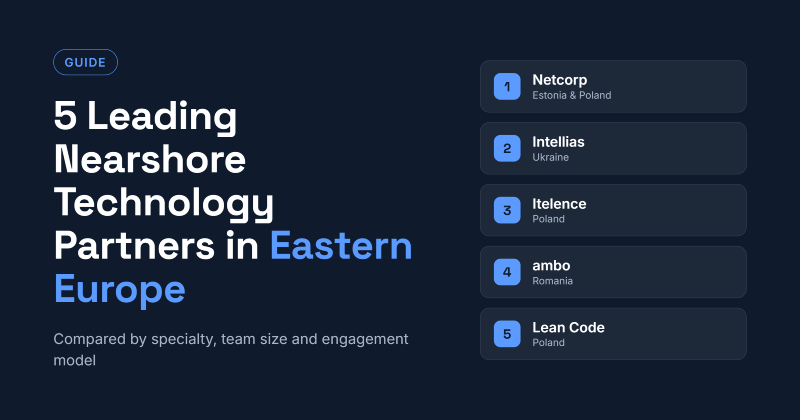
Building a software team used to mean hiring locally or sending work to distant time zones with unpredictable overlap. Eastern Europe changed that math. The region’s concentration of engineering talent, strong language skills, and proximity to Western business hours made it the go-to source for the leading nearshore technology partners in Eastern Europe that US and European companies rely on today.
When to Consider a Nearshore Partner in Eastern Europe
Nearshoring makes the most sense when a company needs skilled engineers fast but doesn’t want the overhead of full-time local hires. If your in-house team has gaps in a specific stack, or you need to staff up for a defined project without committing to permanent headcount, Eastern European partners can typically onboard a working team in one to eight weeks.
And it’s not just speed. The region produces an unusually high number of computer science graduates annually – Poland alone graduates around 100,000 IT professionals per year, according to the Polish Agency for Enterprise Development – and hourly rates run significantly below Western European or US equivalents for comparable skill levels.
The model also suits companies moving into new technology areas. Whether it’s Flutter mobile development, AI/ML pipelines, or cloud-native infrastructure, specialist teams in Eastern Europe often bring deeper domain experience than a generalist agency closer to home.
1. Netcorp Software Development Company
- Best for: Dedicated team extension and full-project delivery for fintech, SaaS, and telecom companies
- Ideal customer: US, UK, or Scandinavian businesses needing long-term engineering capacity
- Standout feature: Estonian HQ with talent sourced from Poland and Estonia, giving clients a single accountable partner across two of the region’s strongest engineering markets
Netcorp has operated for over 15 years with a team of 250-plus in-house developers and an AAA® credit rating – a classification reached by only the top 4.2% of Estonian companies. That financial standing matters: it signals organizational stability for clients who plan to embed a vendor team for 12 months or more.
The company’s technology coverage is broad. Backend options span Java, .NET, Python, PHP, and Go; frontend teams work in React, Vue, and Angular; mobile delivery runs across Flutter, React Native, and native iOS/Android. Cloud and DevOps work covers AWS, Azure, and Google Cloud with Kubernetes, and there’s a dedicated data engineering track using Snowflake, Databricks, Kafka, and Apache Spark.
Clients include Telia, Monese, Payr, and Eesti Energia – names that span telecom, challenger banking, fintech, and energy. Netcorp holds a 4.9 out of 5 rating on Clutch and reports an average project kickstart window of one to eight weeks.
2. Intellias
- Best for: Large-scale AI-enabled product engineering in mobility, fintech, and healthcare
- Ideal customer: Enterprise teams and fast-scaling product companies needing multi-discipline delivery
- Standout feature: Purpose-built mobility practice powering software in 170 million vehicles worldwide
Founded in 2002 in Lviv, Ukraine, Intellias has grown to roughly 3,400 employees across 23 offices in 17 countries. The company’s client list – HERE Technologies, Siemens, LG, TomTom, KIA, HelloFresh, Swissquote Bank, and Deloitte – reflects depth across sectors rather than a single vertical focus.
Service lines span AI-enabled engineering, generative AI, data governance, application modernization, and managed cloud infrastructure. The mobility practice stands out as a real differentiator; not many Eastern European firms can point to embedded software running at that kind of vehicle scale. Financial services, healthcare, retail, and iGaming round out the core industry focus.
Intellias suits organizations that need a large, structured engineering organization rather than a lean specialist team. The Chicago headquarters (500 West Madison Street) makes US client coordination straightforward.
3. Itelence
- Best for: IT nearshoring and BPO for Western European and US corporations entering the Polish market
- Ideal customer: International companies that want to build a back-office or engineering function in Poland with minimal initial risk
- Standout feature: Build-Operate-Transfer model allowing clients to start with a single FTE and scale gradually
Itelence is based in Warsaw (Marszałkowska 126/134) and focuses on helping corporations tap into the Polish labor market for nearshoring and offshoring. The service mix covers IT staff augmentation, managed services, IT contracting, extended project teams, and IT recruitment.
They don’t stop at pure engineering, though. BPO capabilities cover finance and accounting, master data management, business controlling and analytics, and RPA. Technical specializations stretch into SAP and Salesforce consultancy, data engineering, cloud infrastructure, AI, e-commerce development, and service desk operations.
The BOT model works especially well for companies that want to trial a Poland-based team before making a full commitment. Itelence manages the setup, compliance, and recruitment, then hands the team structure over to the client once things are running smoothly. That approach cuts the risk of getting locked into a vendor relationship that turns out to be a poor fit.
4. ambo
- Best for: Long-term custom software development partnerships for mid-size businesses
- Ideal customer: Companies that value stability, direct team access, and multi-decade client relationships
- Standout feature: Average client relationship of 13 years across a 40-person engineering team
Ambo operates out of Cluj-Napoca, Romania, and has been in business for 24 years. It’s a smaller firm by design – 40 engineers – and the data shows what that focus produces: 13-year average client tenure is not typical in this industry.
Technology coverage spans web (React, Angular, Vue, Next.js), mobile (React Native, Swift, Android), desktop (WPF, .NET MAUI, Flutter, Delphi), and IoT and machine vision systems. Backend is primarily Java, C#/ASP.NET Core, Python, and Node.js, with cloud work across AWS, Azure, and Google Cloud.
The team supports full EU time zone overlap and communicates in English, German, and Hungarian. Ambo emphasizes direct access to engineers rather than account-manager layers, on-site visit capability, and a standardized deployment lifecycle aimed at reducing cost variance across projects.
5. Lean Code
- Best for: Flutter-first mobile and web development for product companies scaling their apps
- Ideal customer: Startups and growth-stage businesses needing full-cycle delivery with strong mobile depth
- Standout feature: Google-designated official Flutter consultant with 30-plus Flutter developers, including two Google Developer Experts
Lean Code was founded in 2016 in Warsaw by Łukasz Kosman and Jakub Wojtczak – initially six people. The team has since grown to over 80 engineers, designers, and product strategists, with Flutter as the clear technical center of gravity.
The delivery model runs across three phases: Discovery (scoping workshops, UX/UI design, mobile app audits), Delivery (mobile and web development, custom software, staff augmentation), and Growth (AI work, hosting and DevOps, support and maintenance). The company created Patrol, an open-source Flutter UI testing framework, which gives some indication of where their engineering depth sits.
Client work includes CA24 Mobile for Credit Agricole Bank Polska, plus projects for Virgin Money, Sonova, Millennium Bank, Shell, Tide, and Viessmann. So if your project lives or dies on mobile quality, Lean Code is one of the more specialized options on this list.
Bottom Line
The top nearshore technology partners in Eastern Europe for 2026 span a wide range of company sizes, specializations, and engagement models. Intellias is the right fit for large enterprises that need structured, multi-discipline delivery at scale. Itelence suits organizations building Polish-market teams through a low-risk transfer model. Ambo makes sense for businesses that want a small, stable team they can rely on for years. And Lean Code is the strongest pick for Flutter-centric mobile work.
The choice comes down to team size requirements, technical specialization, and how much involvement your company wants in day-to-day engineering. All five providers represent genuinely different strengths, and matching the model to the actual project need is what determines whether nearshoring works.