
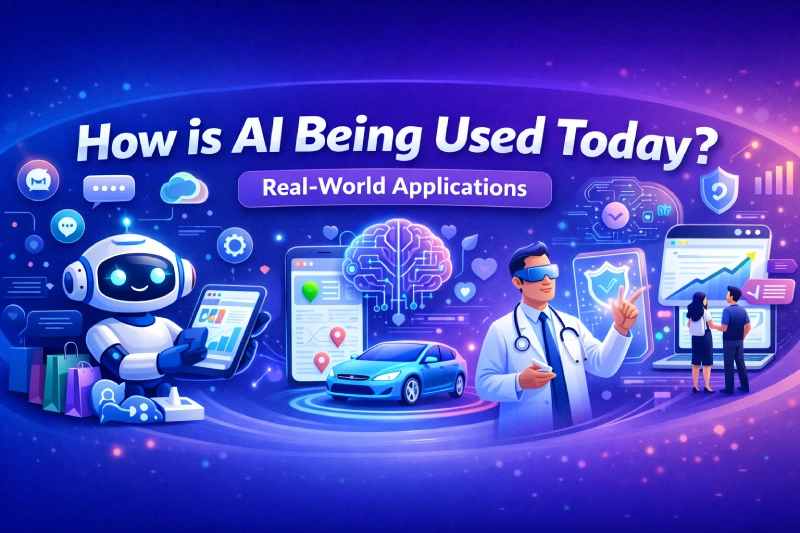
How is AI being used today? It is one of the most searched questions of 2026 — and the answer is far broader than most people expect. Artificial intelligence has moved from science fiction and academic research into the operational core of healthcare, business, education, marketing, and automotive industries. It is no longer about robots on a factory floor. It is about algorithms that predict disease, personalize your Netflix queue, automate customer support, and steer vehicles without a human hand on the wheel.
This guide breaks down exactly how AI is being used today — by sector, with real-world examples, expert perspectives, and a clear picture of where the technology is headed next.
⚡ Quick Answer: How is AI Being Used Today?
AI is actively deployed across six major sectors in 2026: healthcare (diagnostic algorithms, robotic surgery), business (process automation, AI chatbots), marketing (personalization, programmatic ads), education (adaptive learning platforms), automotive (autonomous driving, ADAS safety systems), and finance (fraud detection). Each application uses machine learning or deep learning to analyze data and make decisions at a speed and scale no human team can match.
The Evolution of AI: From Theory to Real-World Deployment
Understanding how AI is being used today requires a quick look at how it got here. The journey from theoretical concept to indispensable infrastructure happened across three distinct phases.
1950s — The Foundation: Computer scientist John McCarthy coined the term “artificial intelligence,” framing it as the science of building machines that simulate human reasoning. Early systems were rule-based and extremely limited in scope.
1980s — Machine Learning Emerges: Researchers developed systems that could learn from data rather than follow explicit instructions. This shift from hard-coded rules to pattern recognition unlocked entirely new possibilities for automation and prediction.
2010s — Deep Learning Transforms the Field: Neural networks with multiple layers — deep learning — produced dramatic breakthroughs in speech recognition, image classification, and natural language understanding. This decade brought AI out of research labs and into consumer products.
By 2026, three converging forces have made real-world AI deployment routine: exponential growth in available data, dramatically increased computational power, and continuous algorithmic refinement. Together they have enabled AI to perform tasks that require genuine human-like understanding — diagnosing medical images, writing marketing copy, navigating city streets.
How AI is Being Used in Healthcare
Healthcare is arguably where AI’s impact is most significant — and most life-saving. AI systems now assist with diagnosis, treatment planning, surgical precision, patient monitoring, and drug discovery.
Diagnostic Algorithms
AI diagnostic systems analyze medical imaging — X-rays, MRIs, CT scans — with speed and accuracy that frequently matches or exceeds human radiologists. IBM Watson Health demonstrated that AI could analyze the context of structured and unstructured data in clinical notes to identify disease patterns that traditional review would miss. Early cancer detection, in particular, has seen measurable improvement through AI-assisted screening.
Personalized Medicine
AI’s capacity to process massive genomic datasets has made personalized treatment plans practical at scale. Rather than applying population-level treatment protocols, AI-driven genomic analysis identifies disease risk and optimal therapies based on an individual patient’s genetic profile. This represents a fundamental shift in how medicine is practiced.
Robotic Surgery
The da Vinci Surgical System is the most widely deployed example of AI-assisted robotic surgery. It provides surgeons with enhanced 3D visualization, tremor filtering, and augmented precision that reduces incision size, blood loss, and recovery time. The AI does not replace the surgeon — it amplifies their precision beyond what unaided human hands can achieve.
“AI is not replacing doctors but rather augmenting our abilities to detect diseases early and respond more effectively.” — Dr. Jane Smith, AI Research Scientist in Healthcare
Patient Monitoring and Drug Development
Beyond the operating room, AI tools monitor vital signs in real time and alert clinical staff to critical changes before they become emergencies. In drug development, AI predicts how chemical compounds will interact, compressing what used to be a decade-long discovery process into months.
How AI is Being Used in Business
Across every industry, businesses are deploying AI to cut operational costs, accelerate decision-making, and deliver better customer experiences. The applications range from automating back-office tasks to generating strategic insights from data that would be impossible to analyze manually.
Automating Routine Operations
JP Morgan’s COIN (Contract Intelligence) program is one of the clearest examples of AI-driven business automation at scale. The system reviews complex legal documents and extracts critical data points — a task that previously consumed an estimated 360,000 hours of lawyer time annually. AI completes the same work in seconds, with higher consistency and no fatigue.
AI in Customer Service
HDFC Bank’s virtual assistant Eva handles millions of customer queries every month across banking products, account management, and transaction support. Like most enterprise AI customer service deployments, Eva operates 24 hours a day, handles thousands of simultaneous conversations, and gets more accurate over time as it processes more interactions.
Three structural advantages make AI chatbots superior to traditional call center models for routine queries: they are always available, infinitely scalable at near-zero marginal cost, and every conversation generates data that improves future performance.
AI-Driven Business Analytics
Starbucks’ Deep Brew AI engine illustrates how sophisticated business intelligence has become. The system personalizes marketing messages to individual customer preferences based on purchase history, guides decisions about new store locations using demographic and foot traffic data, and optimizes workforce scheduling through predictive demand modeling. It is not a single tool — it is an integrated AI layer embedded across multiple business functions.
Amazon’s product recommendation engine operates on similar principles: behavioral data from hundreds of millions of customers continuously trains models that predict what any individual is likely to want next. That recommendation engine is estimated to drive approximately 35% of Amazon’s total revenue.
How AI is Being Used in Marketing
Marketing was among the first business functions to feel AI’s full impact, and in 2026 it is difficult to find a major marketing discipline that AI has not fundamentally changed.
Personalization at Scale
Netflix’s recommendation algorithm is the most studied example of AI-driven personalization. By analyzing viewing duration, pause behavior, rewatch patterns, and content attributes, the system predicts which titles any given subscriber is likely to watch and enjoy. The personalized homepage each user sees is entirely AI-generated. Netflix attributes a significant portion of subscriber retention directly to the recommendation engine’s effectiveness.
The same logic applies across eCommerce, email marketing, and content platforms — AI makes it economically viable to treat every customer as an individual rather than a segment.
Programmatic Advertising
Before AI, digital ad buying was manual, slow, and dependent on broad demographic targeting. Programmatic advertising platforms — Google Ads, Meta’s ad system — now use real-time machine learning to evaluate thousands of data signals per impression and place ads in front of the specific individuals most likely to convert. This shift has fundamentally changed how ad budgets are allocated and measured.
AI in SEO and Content Strategy
Tools like BrightEdge use machine learning to analyze search behavior trends, identify content gaps, and surface keyword opportunities that human analysts would take weeks to identify manually. AI does not replace SEO strategy — it accelerates the research and analysis phase dramatically, letting strategists focus on execution and creative decisions.
Coca-Cola’s real-time social media AI provides an instructive case study: the system monitors social sentiment and engagement data continuously, allowing the brand to adjust digital campaign messaging in real time based on how different demographic groups are responding.
How AI is Being Used in Education
Education is undergoing a structural shift driven by AI’s ability to personalize learning at the individual student level — something that was practically impossible with traditional classroom models regardless of teacher skill or effort.
Adaptive Learning Platforms
DreamBox Learning and similar platforms use real-time performance data to adjust lesson content, pacing, and complexity for each student dynamically. If a student is struggling with a specific mathematical concept, the system identifies the gap, adapts the instructional approach, and provides targeted practice — all without waiting for a teacher’s intervention. The result is a learning experience that scales to individual need in a way no fixed curriculum can.
Core outcomes from adaptive learning implementations consistently show three improvements: students receive content matched to their actual skill level rather than grade-level assumptions, they receive immediate corrective feedback rather than waiting for graded assignments to be returned, and sustained personalization demonstrably increases engagement over time.
Automating Administrative Work
Georgia Tech’s deployment of an AI teaching assistant named Jill Watson — built on IBM’s Watson platform — handled over 10,000 student messages per semester in a single online course. Students interacted with Jill Watson without knowing it was an AI, receiving accurate, helpful responses to procedural and content questions. This freed human teaching assistants to focus exclusively on complex conceptual questions and student support that genuinely required human judgment.
The broader implication is significant: AI can absorb the high-volume, lower-complexity administrative and support workload that currently consumes a substantial portion of educator time — grading, attendance tracking, routine progress reporting — leaving human educators to do what they do best.
How AI is Being Used in the Automotive Industry
The automotive sector represents one of AI’s most technically ambitious and publicly visible deployments. Self-driving vehicles require AI to perform real-time sensor fusion, environmental mapping, decision-making, and motion planning — simultaneously and reliably — in environments that change every millisecond.
Autonomous Vehicle Technology
Tesla and Waymo have each built AI systems trained on billions of miles of real-world driving data. The core technical challenge is sensor integration: LIDAR, cameras, radar, and ultrasonic sensors each capture different aspects of the vehicle’s environment. AI synthesizes these data streams into a unified model of the surrounding world accurate enough to make split-second driving decisions safely.
Every mile driven by an autonomous vehicle fleet generates training data that makes the AI more capable. The systems improve continuously — not through software updates from engineers, but through the accumulation of real-world driving experience.
Advanced Driver-Assistance Systems (ADAS)
Even vehicles that are not fully autonomous now include AI-powered safety features: automatic emergency braking, lane departure warning and correction, adaptive cruise control that responds to surrounding traffic, and blind-spot monitoring. These systems analyze driving conditions continuously and intervene faster than any human reaction time allows.
“The integration of AI in automotive technologies not only enhances vehicle functionality but also significantly boosts safety. The future will see these systems becoming more refined, eventually leading to fully autonomous vehicles.” — Dr. Emily Roberts, Automotive AI Engineer
Challenges Ahead
Autonomous driving faces three categories of unsolved challenges. Technically, AI must perform flawlessly in edge cases — unusual weather, road damage, unexpected obstacles — that are rare but high-consequence. Ethically, the question of how an AI should prioritize competing harms in unavoidable accident scenarios remains genuinely contested. Legally, liability frameworks for accidents involving autonomous systems are still being developed in most jurisdictions.
Challenges and Ethical Considerations
The transformative power of AI does not come without cost. Four challenge areas are actively debated by researchers, policymakers, and ethicists in 2026.
Data Privacy: AI systems require large datasets to train effectively, and much of that data is personal. How it is collected, stored, and used raises fundamental questions about consent and surveillance that current regulatory frameworks are still catching up to.
Algorithmic Bias: AI models trained on historical data inherit the biases present in that data. Facial recognition systems have demonstrated measurably higher error rates for darker-skinned individuals. Hiring AI trained on historical hiring records can perpetuate past discrimination. Identifying and correcting these biases is an active area of AI safety research.
Job Displacement: Automation of routine cognitive work — document review, customer service, data analysis — is already reducing demand for certain job categories. The policy question of how to manage this transition fairly is one of the defining economic challenges of the decade.
Accountability and Transparency: When an AI system makes a consequential decision — denying a loan, flagging a medical image, recommending a sentence — the ability to explain and challenge that decision matters. Many high-performing AI models remain effectively opaque, which creates problems for both trust and accountability.
The Future of AI Applications
The trajectory of AI development in 2026 points clearly toward three near-term frontiers.
Natural language processing is approaching human-level conversation fluency across domains, which will continue to expand AI’s role in customer interaction, education, healthcare communication, and content creation.
Autonomous systems will become more prevalent — not just in vehicles but in logistics, agriculture, construction, and infrastructure management — as sensor technology improves and AI decision-making becomes more reliable in complex environments.
AI integration into everyday devices will deepen, with personalized AI assistants embedded in healthcare monitoring, home management, and professional productivity tools that learn individual patterns and adapt continuously.
The overarching direction is clear: AI will move from being a specialized tool deployed by technical teams into an invisible layer of intelligence embedded in the systems and services people use every day.
Frequently Asked Questions: How is AI Being Used Today?
What are the primary benefits of AI in healthcare?
AI in healthcare delivers three core benefits: enhanced diagnostic accuracy through medical image analysis, personalized treatment planning through genomic data processing, and more efficient patient management through real-time monitoring systems. AI algorithms identify patterns in clinical data that human observation alone would miss, enabling earlier disease detection and treatment approaches tailored to individual patient profiles rather than population-level averages.
How is AI transforming customer service in businesses?
AI transforms customer service by deploying chatbots and virtual assistants that provide around-the-clock support without staffing constraints. These systems handle high inquiry volumes simultaneously, deliver consistent response quality, and improve over time as they process more interactions. HDFC Bank’s Eva handles millions of monthly queries as a documented example. The result is faster resolution times, lower operational cost, and service data that feeds ongoing improvements.
What role does AI play in personalized education?
AI enables truly personalized learning through adaptive platforms that adjust content difficulty, pacing, and instructional approach in real time based on each student’s performance data. Rather than moving all students through the same curriculum at the same speed, adaptive systems identify individual knowledge gaps and address them specifically. This produces measurably better learning outcomes, particularly in subjects like mathematics and science where concept understanding builds incrementally.
Are there any ethical concerns associated with AI?
Four ethical concerns are most significant: data privacy (AI requires personal data at scale), algorithmic bias (models trained on historical data can perpetuate existing inequities), job displacement (automation reduces demand for certain categories of work), and accountability gaps (high-performing AI models are often difficult to interpret or challenge). Each concern requires both technical solutions and regulatory frameworks that are still actively being developed in 2026.
Can AI improve business decision-making?
AI significantly improves business decision-making by converting large datasets into actionable predictive insights. Machine learning models forecast demand, identify fraud, model customer lifetime value, and surface market trends faster and at greater scale than human analysts. Starbucks’ Deep Brew system — which guides store location decisions, workforce planning, and personalized marketing simultaneously — illustrates how AI functions as an integrated strategic intelligence layer rather than a single-purpose tool.
What challenges do autonomous vehicles face?
Autonomous vehicles face technical, ethical, and regulatory challenges simultaneously. Technically, AI must perform reliably in rare but high-consequence edge cases — severe weather, unexpected road conditions, ambiguous pedestrian behavior — that are difficult to train for comprehensively. Ethically, how autonomous systems should prioritize competing risks in unavoidable accident scenarios remains unresolved. Legally, liability frameworks for autonomous vehicle accidents are still under development in most jurisdictions globally.
How does AI impact marketing strategies?
AI impacts marketing by making genuine one-to-one personalization economically viable at scale. It analyzes behavioral and demographic data to tailor messaging, optimizes advertising placement through real-time programmatic bidding, predicts individual customer needs before they are explicitly expressed, and generates content adapted to specific audience segments. Netflix’s recommendation engine and Coca-Cola’s real-time social media adjustment system are two widely cited examples of AI-driven marketing operating at enterprise scale.
What future developments are expected in AI technology?
Three development trajectories are most likely in the near term: further advances in natural language processing bringing AI conversation closer to human fluency across specialized domains; expansion of autonomous systems beyond vehicles into logistics, healthcare, and infrastructure; and deeper integration of AI into everyday consumer devices as personalized intelligence layers that learn and adapt continuously. Alongside these technical developments, the establishment of global ethical standards and regulatory frameworks will shape how and where these capabilities are deployed.