

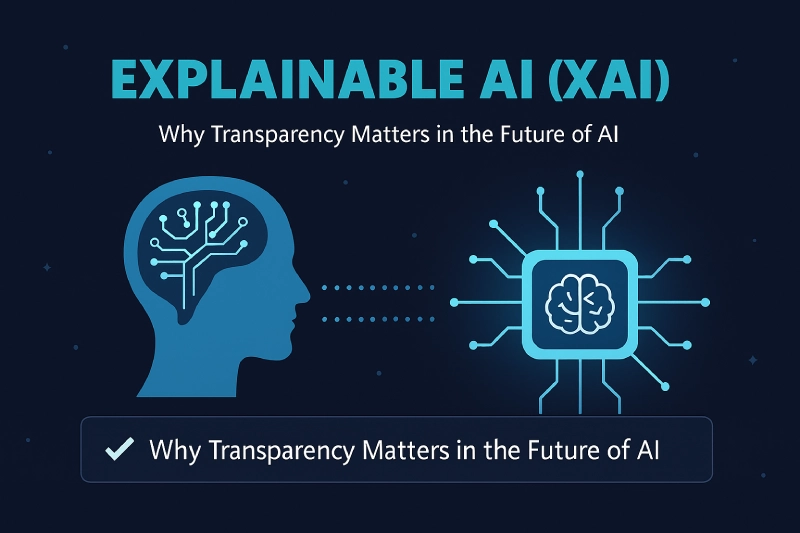
Artificial intelligence systems are making consequential decisions every day — approving loans, flagging fraud, recommending medical treatments, and steering autonomous vehicles. But most people interacting with these systems have no idea how they reach their conclusions. That gap between AI capability and AI understanding is exactly what explainable AI (XAI) is designed to close.
XAI makes artificial intelligence systems interpretable to the humans who use them, regulate them, and are affected by them. It answers the question every user instinctively asks: why did the AI decide that? In 2026, with regulators tightening requirements and public trust in AI under scrutiny, explainability has shifted from a technical preference to a business and legal necessity.
This guide covers what explainable AI is, how it works, where it is already being deployed, and what the next five years look like for organizations that get it right — and those that do not.
⚡ Quick Answer: What is Explainable AI (XAI)?
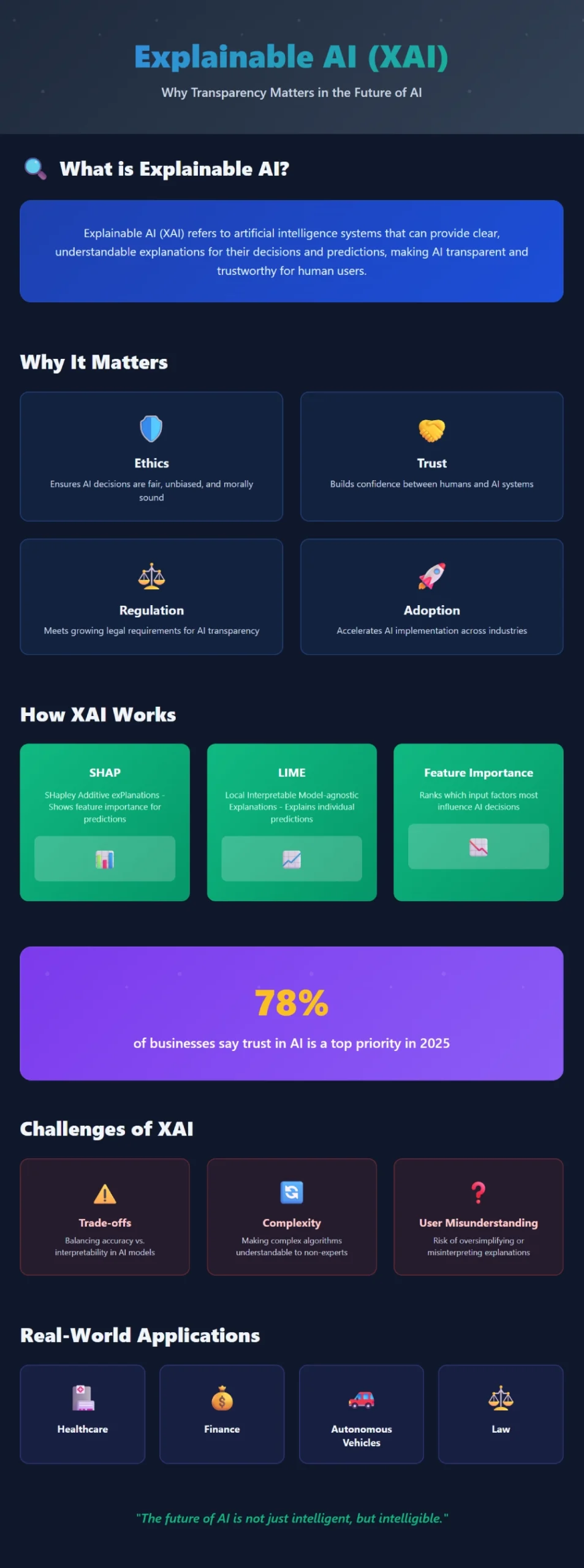
Explainable AI (XAI) refers to methods and tools that make AI decision-making understandable to humans. Instead of treating AI models as opaque black boxes, XAI reveals the reasoning behind predictions, classifications, and recommendations. Core techniques include SHAP (Shapley Additive Explanations), LIME (Local Interpretable Model-agnostic Explanations), and feature importance visualization. XAI is now a legal requirement for high-risk AI systems under the EU AI Act.
What is Explainable AI (XAI)?
Explainable AI — commonly abbreviated as XAI — refers to the set of methods, tools, and design principles that make AI decision-making understandable to human observers. Rather than treating machine learning models as impenetrable black boxes that produce outputs without explanation, XAI surfaces the reasoning process: which inputs influenced the decision, how much weight each factor carried, and why one outcome was selected over another.
A useful analogy is a teacher showing their working on the board. The answer alone has limited educational value. The reasoning behind it — the step-by-step logic — is what builds understanding and trust. XAI applies the same principle to machine learning models operating in high-stakes environments.
This matters most when AI influences decisions that affect real people. A medical diagnosis algorithm, a credit scoring model, a content moderation system, a recidivism risk calculator — in each of these contexts, the inability to explain a decision is not just a technical limitation. It is an accountability failure.At its foundation, XAI operates at the intersection of three principles: AI interpretability (can the model’s behavior be understood?), AI transparency (is the decision process visible?), and ethical AI (does the system operate fairly and accountably?). All three are required for AI to be trustworthy in practice, not just in theory.
Why Transparency in AI Matters
Transparency in AI is not a technical nicety — it is the foundation on which responsible AI adoption is built. Without the ability to explain decisions, even technically excellent AI systems face rejection from users, resistance from regulators, and liability exposure for the organizations deploying them.
Building User Trust
Consider a mortgage application denied by an AI underwriting system. A flat rejection with no explanation is not just frustrating — it erodes confidence in the entire process and creates grounds for a discrimination complaint. When applicants can see which factors drove the decision — income-to-debt ratio, credit history, employment stability — they understand the outcome, can assess its fairness, and know what to address before reapplying.
This dynamic applies across every AI deployment that affects people directly. Transparency converts a black-box authority into an accountable system. That shift is what makes users willing to engage with AI-powered services rather than resist or circumvent them.
Meeting Legal and Regulatory Requirements
Regulatory pressure on AI transparency has accelerated sharply. The EU AI Act — the most comprehensive AI regulatory framework in effect as of 2026 — mandates explainability as a legal requirement for high-risk AI systems across healthcare, financial services, law enforcement, and education. Organizations deploying AI in these categories without adequate explainability mechanisms face fines, operational restrictions, and potential liability for adverse decisions.
This is no longer a compliance checkbox for future consideration. It is an immediate operational requirement for any organization using AI at scale in regulated industries.
Accelerating Business Adoption
Beyond compliance, explainability solves a practical adoption problem. Business leaders, operations managers, and front-line employees are far more willing to incorporate AI tools into their workflows when they understand how those tools work. The alternative — asking people to act on outputs from a system they do not understand and cannot audit — generates organizational resistance that slows or stalls AI deployment entirely.
In finance and insurance particularly, explainability has repeatedly proven to be the deciding factor between an AI system that gets deployed and one that gets shelved after pilot testing.
How Explainable AI Works: Core Techniques
Explainable AI is not a single technology — it is a collection of interpretability methods, each suited to different model types and explanation needs. The three most widely deployed approaches are SHAP, LIME, and feature importance visualization.
SHAP (Shapley Additive Explanations)
SHAP assigns a contribution score to each input feature for every individual prediction a model makes. The underlying mathematics come from cooperative game theory — specifically, Shapley values — which calculate each feature’s fair contribution to the final output by testing all possible feature combinations.
In practice, a credit scoring model using SHAP might reveal that “income level” contributed 60% to an approval decision, “payment history” contributed 30%, and “account age” contributed the remaining 10%. This level of granularity lets compliance teams audit decisions, helps users understand outcomes, and gives developers insight into whether the model is weighting features appropriately.
SHAP is model-agnostic, meaning it can be applied to neural networks, gradient boosting models, and linear models alike — which makes it the most widely adopted XAI technique in production environments.
LIME (Local Interpretable Model-agnostic Explanations)
LIME takes a different approach. Rather than explaining the model globally, it explains individual predictions by constructing a simpler, interpretable model around a single instance and its near neighbors. This local approximation reveals which features most influenced that specific prediction.
For an image classification model, LIME might highlight the specific regions of an image — the texture of fur, the shape of ears — that caused the model to classify it as a cat rather than a dog. For a text classification model, it might underline the specific words that triggered a spam classification. This makes LIME particularly valuable for explaining decisions to end users who do not need to understand the full model but do need to understand their specific result.
Feature Importance and Visualization
Sometimes the most effective explanation is the simplest one. Feature importance rankings — displayed as bar charts, heatmaps, or ranked lists — show which inputs the model weighs most heavily across its predictions in aggregate.
A weather forecasting model might display a feature importance chart showing that humidity contributed 45% to the rain probability prediction, followed by barometric pressure at 30% and temperature at 25%. This kind of visualization makes AI reasoning accessible to non-technical stakeholders — business analysts, regulators, patients, customers — who need to understand the system without needing to understand the mathematics behind it.
Key Challenges of Explainable AI
Explainability is not a solved problem. Three tension points persist in 2026 that any organization implementing XAI must navigate.
The Accuracy-Interpretability Trade-off: The most powerful AI models — large neural networks, deep learning systems with hundreds of millions of parameters — are consistently the hardest to interpret. Simpler, more interpretable models like decision trees are inherently more transparent but sacrifice predictive accuracy on complex tasks. XAI techniques like SHAP and LIME partially bridge this gap, but they provide approximations of model behavior rather than complete transparency into it.
Explanation Complexity: There is a genuine risk that XAI explanations become too detailed or technical to be useful to their intended audience. An explanation designed to satisfy a data scientist’s audit requirements may be completely opaque to a loan applicant trying to understand why their application was rejected. Designing explanations for the specific audience that needs them — not just for technical completeness — is an ongoing design challenge.
Misinterpretation Risk: Simplified explanations create a different problem: users may develop false confidence that they fully understand a system’s behavior based on a partial view. A LIME explanation for one prediction does not generalize to the model’s behavior on other inputs. Communicating the appropriate scope and limitations of each explanation is an underappreciated part of responsible XAI implementation.
Real-World Applications of XAI
Explainable AI is operational across industries where decision stakes are high and accountability requirements are strict.
Healthcare
AI diagnostic systems in clinical settings use XAI to communicate the reasoning behind treatment recommendations to the clinicians reviewing them. A model recommending a specific oncology treatment plan might display that the patient’s genetic markers contributed most heavily to the recommendation, followed by specific lab result patterns and disease progression indicators. Doctors can evaluate whether that reasoning aligns with their clinical judgment before acting on the recommendation — a critical safeguard that opaque systems cannot provide.
Finance
Banks and lending institutions deploy XAI to generate auditable explanations for credit decisions, fraud flags, and risk assessments. When an AI system flags a transaction as potentially fraudulent, SHAP values might reveal that the combination of unusual geographic location, atypical purchase category, and transaction size outside normal patterns collectively triggered the flag. This explanation serves compliance teams, supports customer disputes, and satisfies regulatory audit requirements simultaneously.
Autonomous Vehicles
Self-driving systems use XAI to document and explain the reasoning behind driving decisions — a braking event, a lane change, a routing choice — in formats that engineers can use for debugging and regulators can use for safety assessment. When an accident or near-miss occurs, XAI logs allow investigators to reconstruct exactly what the system perceived and why it acted as it did. This transparency is fundamental to the regulatory approval process for autonomous vehicle deployment.
Legal Analytics
AI tools used in legal research and case outcome prediction rely on XAI to clarify which precedents, statutory language, or argument structures the model weighted most heavily in its analysis. This prevents the concerning scenario where legal conclusions are shaped by opaque algorithmic outputs that neither lawyers nor judges can interrogate or challenge.
Future Outlook: XAI from 2026 to 2030
The trajectory for explainable AI over the next four years points toward one outcome: explainability will shift from competitive differentiator to baseline expectation.
Regulatory momentum is the primary driver. As the EU AI Act implementation continues and equivalent frameworks develop in other major jurisdictions, organizations deploying AI in high-risk categories without adequate explainability will face increasing legal exposure. The question for compliance teams is no longer whether explainability is required but how to implement it efficiently at scale.
Standardized XAI frameworks are a likely near-term development — analogous to financial accounting standards — that would allow AI systems to be independently audited and certified for explainability compliance, much like financial statements are certified for accuracy. Organizations operating in multiple regulatory jurisdictions would benefit significantly from standardized approaches over the current fragmented landscape.
The business case will sharpen as well. As AI becomes more embedded in customer-facing decisions, organizations that can explain their systems clearly will build measurably stronger customer trust than those that cannot. By 2030, the ability to explain AI decision-making may be as fundamental to enterprise AI credibility as data security is today.
How Developers and Businesses Can Implement XAI Today
Getting started with explainable AI does not require rebuilding your technology stack. Four practical entry points exist for organizations at any stage of AI maturity.
Start with interpretable models where accuracy requirements allow. For lower-stakes classification and prediction tasks, decision trees, logistic regression, and linear models offer strong interpretability without the explainability overhead that complex models require. Reserve deep learning for tasks where the accuracy gains genuinely justify the interpretability cost.
Integrate SHAP or LIME into your existing ML pipelines. Both libraries are compatible with TensorFlow, PyTorch, scikit-learn, and most other popular machine learning frameworks. Adding SHAP or LIME explanations to model outputs is a practical first step that does not require replacing existing models.
Build explanation interfaces for non-technical stakeholders. Raw SHAP values and feature contribution scores mean little to business users, compliance officers, or customers. Invest in dashboards and visualization layers that translate model explanations into language and formats that decision-makers and affected individuals can actually interpret and act on.
Align with established ethical AI frameworks. Google’s Responsible AI Practices, the EU AI Act guidelines, and the NIST AI Risk Management Framework each provide structured approaches to integrating explainability into AI governance. Mapping your XAI implementation against these frameworks also prepares you for regulatory scrutiny.
Frequently Asked Questions: Explainable AI (XAI)
What is the difference between explainable AI and interpretable AI?
Interpretability refers to how inherently understandable a model’s mechanics are — a linear regression is interpretable because you can read its coefficients directly. Explainability refers to techniques applied after the fact to make complex, less-interpretable models understandable — SHAP and LIME are explainability tools applied to models that are not inherently transparent. Interpretability is a model property; explainability is a process applied to any model.
Why is explainable AI important in healthcare?
Healthcare AI operates in a domain where a wrong or unexplained decision can directly harm a patient. Clinicians need to understand why an AI recommends a particular diagnosis or treatment before acting on it — the recommendation alone is not sufficient basis for a consequential medical decision. XAI provides that reasoning, allowing doctors to evaluate whether the AI’s logic aligns with their clinical judgment. Regulatory frameworks in most jurisdictions also require explainability for medical AI systems classified as high-risk.
Is explainable AI required by law?
In the European Union, yes. The EU AI Act mandates explainability for AI systems classified as high-risk, which includes applications in healthcare, financial services, employment, education, and law enforcement. Organizations deploying AI in these categories without adequate explainability mechanisms face regulatory sanctions. Similar requirements are developing in other jurisdictions, and global organizations should treat EU AI Act compliance as the current benchmark standard.
What is the accuracy-explainability trade-off in AI?
The most accurate AI models — large neural networks and ensemble methods with millions of parameters — are typically the hardest to interpret directly. Simpler, more transparent models sacrifice some predictive accuracy for interpretability. XAI techniques like SHAP and LIME partially bridge this gap by providing post-hoc explanations for complex models, but they offer approximations of model behavior rather than complete internal transparency. The appropriate balance depends on the stakes of the application and the explanation needs of the end user.
How do SHAP and LIME differ?
SHAP (Shapley Additive Explanations) provides global and local explanations by calculating each feature’s contribution to a prediction using game theory mathematics. It is computationally intensive but produces consistent, theoretically grounded explanations. LIME (Local Interpretable Model-agnostic Explanations) explains individual predictions by building a simple surrogate model around a specific instance. LIME is faster and more accessible but provides local explanations only — it does not generalize to the model’s overall behavior. In practice, SHAP is preferred for auditing and compliance use cases; LIME is often more useful for end-user-facing explanations.
Can small businesses implement explainable AI?
Yes — and the barrier is lower than most assume. Open-source SHAP and LIME libraries are freely available and compatible with standard machine learning frameworks. For businesses using off-the-shelf AI tools rather than custom models, many enterprise AI platforms now include built-in explainability dashboards as standard features. The more significant investment is in designing clear explanation interfaces for the people who need to use them, which is a design and communication challenge rather than a technical one.


![Read more about the article AI Jobs in 2026: Roles Replaced vs. Roles Created [With Infographic]](https://sanishtech.com/wp-content/uploads/2025/09/ai-jobs-featured-banner-300x200.webp)
