

![You are currently viewing AI Jobs in 2026: Roles Replaced vs. Roles Created [With Infographic]](https://sanishtech.com/wp-content/uploads/2025/09/ai-jobs-featured-banner.webp)
The conversation around AI jobs in 2026 is not as simple as “AI takes jobs.” The reality is more nuanced — and more interesting. Yes, automation is replacing entire categories of repetitive, rule-based work. But simultaneously, AI is generating a wave of new roles that did not exist five years ago: prompt engineers, AI ethicists, human-AI interaction designers, and more.
Understanding which side of this divide your career sits on — and what to do about it — is one of the most important professional questions of 2026. This guide breaks down exactly which jobs are shrinking, which are growing, and how workers in every industry can position themselves for what comes next.
⚡ Quick Answer: How is AI Affecting Jobs in 2026?
AI is automating repetitive, rule-based roles — data entry, Tier 1 customer support, telemarketing, basic bookkeeping — while simultaneously creating demand for new careers: AI prompt engineers, AI ethicists, data curators, AI security analysts, and human-AI interaction designers. Experts project that by 2030, AI will create more jobs than it eliminates — but the transition requires deliberate reskilling.
AI Jobs 2026: The Big Picture
Artificial intelligence is no longer a future-tense concept in the labour market — it is an active force reshaping hiring, compensation, and skill demand across virtually every industry. By 2026, the pattern is clear enough to describe with confidence: AI is compressing the bottom of the job market while expanding the top.
The roles being displaced share a common profile — they involve predictable, high-volume tasks that follow defined rules and generate structured outputs. Data entry, routine customer queries, standard bookkeeping transactions. These are tasks where AI does not just match human performance — it exceeds it, at a fraction of the cost and without fatigue or error rate variation.
The roles being created share a different profile — they require judgment about AI systems, design of AI interfaces, oversight of AI outputs, or the kind of creative and empathetic reasoning that machine learning models still cannot replicate reliably. These are not niche roles for researchers. They are operational positions being filled at scale by companies in every sector.
The net result is a bifurcation: workers with skills that complement AI are seeing stronger demand and higher wages in 2026, while workers whose primary skills overlap with what AI now automates are facing genuine displacement pressure. The transition between those two positions is the central workforce challenge of the decade.
Jobs AI Is Replacing in 2026
Automation has been displacing rule-based work for decades, but the pace accelerated sharply when large language models and multimodal AI reached production-grade quality. These are the roles facing the steepest decline in 2026.
Data Entry Clerks
AI-powered OCR (optical character recognition) and natural language processing tools now process bulk data extraction, validation, and entry at speeds no human team can approach — and with error rates that improve continuously. The demand for full-time data entry clerks has dropped significantly in industries from logistics to healthcare administration. The remaining human roles are concentrated in exception handling: flagging records the AI could not process with sufficient confidence and making judgment calls that require contextual understanding.
Customer Support — Tier 1
Conversational AI now resolves an estimated 70–80% of routine customer support queries without human involvement. Chatbots handle account inquiries, order tracking, standard troubleshooting, refund eligibility checks, and FAQ responses with response times and consistency that human agents cannot match at scale. The Tier 1 support roles that remain are increasingly focused on escalations — situations involving genuine complexity, customer distress, or edge cases where emotional intelligence adds measurable value.
Telemarketers
AI-driven voice agents now conduct outbound sales campaigns with personalization capabilities — adjusting tone, pacing, and offer based on real-time customer responses — that represent a fundamental shift from the scripted calls of traditional telemarketing. This has automated a substantial portion of traditional call-center outreach volume. New roles have emerged around these systems — quality assurance, AI campaign management, and voice agent training — but they require substantially different skills than the positions they replace.
Retail Cashiers
Self-checkout technology combined with AI-powered loss prevention systems has significantly reduced cashier demand across large-format retail. The shift is most visible in grocery, big-box, and convenience retail. Major retailers are not eliminating customer-facing staff entirely — but they are redistributing those roles away from transaction processing and toward customer experience, product expertise, and problem resolution.
Basic Accounting and Bookkeeping
The routine layer of accounting work — expense tracking, invoice processing, bank reconciliation, standard tax calculations, payroll processing — is now largely automated through AI-integrated accounting platforms. Accountants in 2026 spend significantly less time on data processing and significantly more time on strategic financial analysis, regulatory compliance, client advisory work, and auditing AI-generated outputs for accuracy and anomalies.
Jobs AI Is Creating in 2026
For every category of work being compressed by automation, a corresponding set of new roles is expanding. These positions range from highly technical to fundamentally human — but all of them exist because of AI, not despite it.
AI Prompt Engineers
Prompt engineering emerged as a distinct professional discipline as large language models became embedded in enterprise workflows. Companies hire prompt specialists to design, test, and optimize the instructions that shape how AI systems respond across customer service, content generation, code assistance, and internal knowledge management applications. The role requires a combination of linguistic precision, systems thinking, and domain expertise in the application area — a genuinely novel skill set that commands strong compensation in 2026.
AI Ethicists and Compliance Officers
Every organization deploying AI in consequential contexts — hiring, lending, healthcare, content moderation — needs professionals who can evaluate whether those systems operate fairly, identify and correct bias, and ensure compliance with evolving regulatory requirements like the EU AI Act. AI ethicists bridge technology, law, organizational policy, and social impact. As regulatory pressure intensifies globally, demand for this role is growing faster than the talent supply can fill it.
Human-AI Interaction Designers
These are the UX specialists of the AI era. As AI interfaces become embedded in consumer products, enterprise software, and public services, designing interactions that feel intuitive, trustworthy, and genuinely useful to human users is a distinct design discipline. Human-AI interaction designers think about how people form mental models of AI systems, where those models break down, and how interface design can bridge the gap between AI capability and user understanding.
AI Trainers and Data Curators
Machine learning models improve through high-quality training data — and the curation, labeling, and quality assurance of that data is fundamentally human work. AI trainers review model outputs, identify errors and edge cases, label ambiguous examples, and provide feedback that shapes model behavior over time. Data curators ensure that the datasets used to train models are accurate, representative, and free from the biases that would otherwise be encoded into model outputs. These roles power everything from healthcare diagnostics to autonomous driving systems.
AI Security Analysts
AI has opened a new attack surface in cybersecurity. Adversarial attacks on machine learning models, AI-generated phishing at scale, deepfake-based social engineering, and automated vulnerability exploitation have all become active threat vectors. AI security analysts specialize in defending against threats that AI itself enables — auditing models for adversarial vulnerabilities, monitoring AI system behavior for signs of manipulation, and developing defensive countermeasures against AI-powered attacks.
Robotics Maintenance Technicians
The scale-up of AI-powered robotics in logistics warehouses, agricultural operations, healthcare facilities, and manufacturing plants has created substantial demand for technicians who can maintain, calibrate, and repair these systems. Unlike traditional maintenance roles, robotics technicians must understand both the physical hardware and the AI software controlling it — a skill combination that is currently in short supply relative to demand.
AI Jobs Infographic: Replaced vs. Created
The infographic below visualizes the full picture of AI’s impact on employment in 2026 — which roles are declining, which are growing, and how the balance of loss versus creation maps across industries.
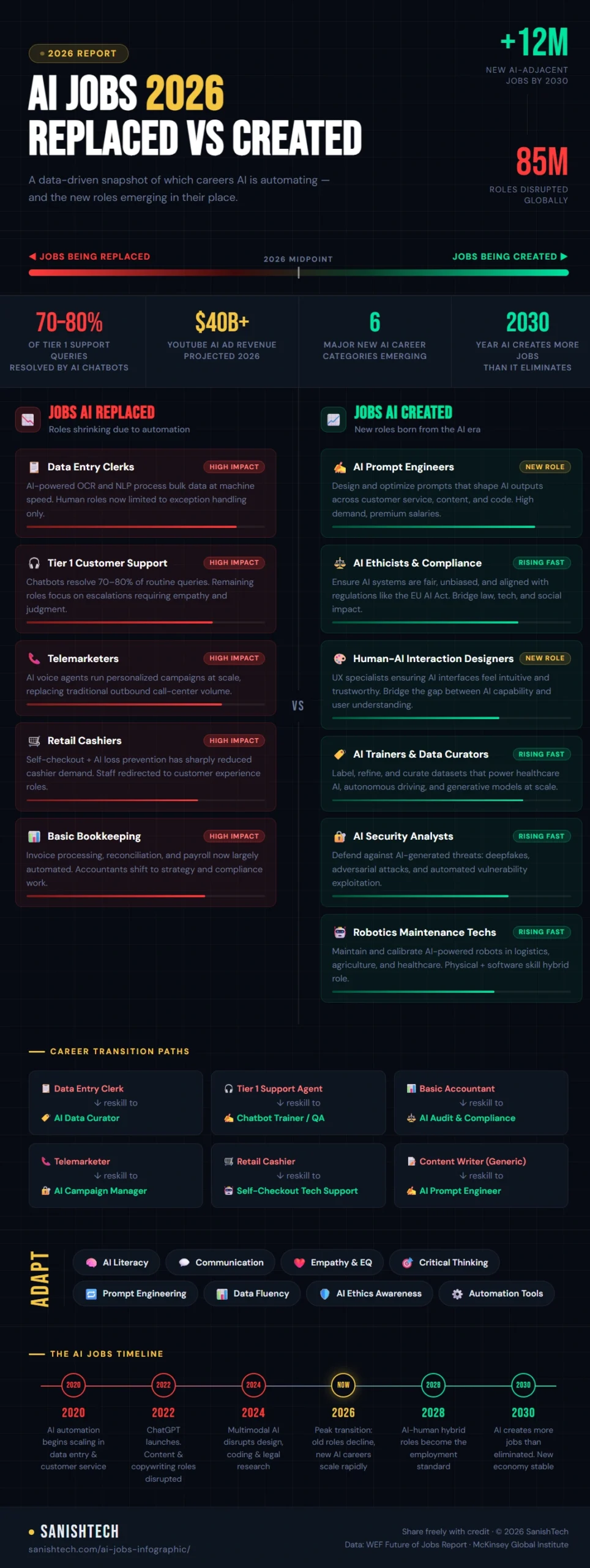
The pattern the infographic makes visible is this: AI does not simply erase jobs — it transforms them. Clerical and transactional roles decline while analytical, supervisory, and human-facing roles grow. The workers best positioned for 2026 and beyond are those moving deliberately from the left side of that graphic to the right.
Want to embed this infographic on your site? Copy the code below and paste it into your blog or website. Please credit SanishTech with a backlink.
What This Means for the Future of Work
The AI future of work is hybrid, not apocalyptic. The scenario where AI simply eliminates work does not align with what the evidence shows — historically, major technological shifts have consistently created more jobs than they eliminated, though the distribution of those jobs and the skills they require changes dramatically.
The more accurate frame for 2026 is compression and elevation. AI compresses demand for the lowest-complexity layer of cognitive work — the tasks that are high in volume but low in judgment requirement. It simultaneously elevates demand for the layer above that: work that requires evaluating AI outputs, making decisions that require contextual understanding, managing systems, and engaging with people in ways that require genuine emotional and social intelligence.
The workers navigating this transition successfully share a common approach: they are using AI as a productivity multiplier rather than treating it as a competitor. An accountant who automates routine bookkeeping and redirects that time toward strategic client advisory work is more valuable in 2026 than one who does the same bookkeeping manually. A customer support agent who manages AI escalations and handles complex emotional situations is more valuable than one handling Tier 1 queries that a chatbot now resolves faster.
By 2030, the expert consensus is that AI will have created more jobs than it eliminated — but that transition will be uneven across industries and geographies, and it will be significantly faster for workers who invest in relevant skills now rather than waiting.
How Workers Can Adapt and Reskill in 2026
The most constructive response to AI-driven job displacement is not anxiety — it is preparation. Workers across every industry have actionable paths to position themselves on the right side of the AI jobs divide.
Develop working familiarity with AI tools. You do not need to become a machine learning engineer. But understanding how to work effectively with prompt-based AI systems, automation tools, and AI-assisted analytics platforms is rapidly becoming a baseline professional competency — equivalent to knowing how to use spreadsheets was in the 1990s.
Invest deliberately in irreplaceable skills. Complex communication, empathy, creative problem-solving, and contextual judgment are not just soft skills — they are the competencies that AI cannot replicate reliably and that will command premium value as the labor market rebalances. These are worth active investment, not passive reliance.
Explore adjacent career paths that your existing skills transfer to. The transition does not have to start from zero. A Tier 1 customer support agent has domain knowledge that transfers directly to chatbot training and quality assurance. A data entry clerk has data accuracy skills that transfer to AI output review and data curation. Identifying the adjacent AI-adjacent role and building toward it incrementally is more achievable than most workers realize.
Use the expanding ecosystem of free and low-cost learning resources. The volume of AI and data skill training available through online platforms has grown dramatically in 2026. Coursera, edX, Google’s AI courses, and numerous platform-specific certification programs offer practical pathways to the skills that AI-adjacent roles require — many at no cost.
The core principle is straightforward: do not compete with AI on its strongest ground. Compete on yours — and use AI to amplify what you are already good at.
Frequently Asked Questions: AI Jobs in 2026
Which jobs is AI most likely to replace in 2026?
AI is most actively displacing roles characterized by high volume, low variability, and rule-based decision-making. In 2026, the most affected categories are data entry and document processing, Tier 1 customer support, outbound telemarketing, retail transaction processing, and routine bookkeeping. These roles are not disappearing overnight, but full-time demand is contracting steadily as AI systems handle an increasing proportion of the workload with greater speed and consistency.
What new jobs is AI creating in 2026?
The fastest-growing AI-adjacent roles in 2026 include AI prompt engineers, AI ethicists and compliance officers, human-AI interaction designers, AI trainers and data curators, AI security analysts, and robotics maintenance technicians. These positions require skills that are complementary to AI — the ability to evaluate, direct, improve, secure, and design around AI systems — rather than competing with what AI does best.
Will AI replace all jobs eventually?
The historical pattern of major technological shifts suggests this is unlikely. Every significant wave of automation — from mechanization to computing — has ultimately created more jobs than it eliminated, while transforming the nature and skill requirements of work. AI is expected to follow the same pattern over the long term. The near-term challenge is the transition period: workers whose primary skills overlap with what AI now automates face real displacement pressure, and the speed of adaptation matters.
What skills are most valuable in an AI-driven job market?
Three skill categories carry the most value in the 2026 labor market. First, AI literacy — practical ability to work with AI tools, evaluate AI outputs, and design effective AI-assisted workflows. Second, judgment and contextual reasoning — the capacity to make complex decisions in ambiguous situations where AI outputs require human evaluation and override. Third, interpersonal and communication skills — empathy, persuasion, conflict resolution, and relationship management, which remain firmly outside what current AI systems can replicate.
How can workers reskill for AI-related careers?
The most effective reskilling paths in 2026 combine three elements: targeted online learning (Google AI certificates, Coursera machine learning courses, platform-specific AI tool certifications), practical application in a current role (identifying one repetitive workflow to automate, then building on that), and lateral career exploration (identifying which AI-adjacent roles align with existing domain expertise). The transition does not require becoming a developer — it requires developing enough AI literacy to work effectively alongside AI systems in your existing field.
Is AI creating more jobs than it is destroying?
The current evidence in 2026 shows a mixed picture that varies significantly by industry and geography. In manufacturing, logistics, and administrative services, net job reduction is measurable. In technology, healthcare, creative industries, and professional services, AI-adjacent job creation is outpacing displacement. The global projection — that AI will create more jobs than it eliminates by 2030 — appears on track, but the geographic and demographic distribution of those new jobs does not automatically match the distribution of displaced workers, which is where policy and reskilling investment matter most.