

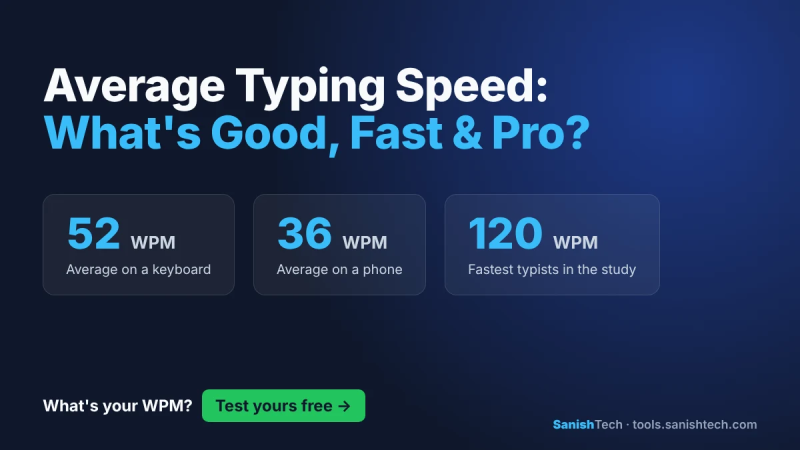
The average typing speed is about 52 words per minute (WPM) on a computer keyboard and about 36 WPM on a smartphone, according to the two largest typing studies ever run. Most people type somewhere between 35 and 65 WPM. Anything above 70 WPM is fast, and professional typists usually work at 60–90 WPM or more.
Want to know where you stand? Take the free typing speed test — it takes 60 seconds, needs no sign-up, and shows your net WPM, accuracy and the exact keys slowing you down.
What’s your WPM? Test it free in 60 seconds →
What is the average typing speed in 2026?
The best data we have comes from a 2018 study by Aalto University (Finland) and the University of Cambridge. Researchers analysed 136 million keystrokes from 168,000 volunteers in more than 200 countries. The headline result:
- Average speed: 52 WPM
- Fastest typists: about 120 WPM on randomised sentences
- Professionally trained typists of the 1970s and 80s typically reached 60–90 WPM
One honest caveat: most volunteers were younger, already interested in typing, and over 70% had taken a touch-typing class. So the true average across everyone who uses a computer is probably a little lower than 52 WPM. That’s why many guides still quote 40 WPM as “average”.
Bottom line: if you type around 40–50 WPM, you’re normal. Above 52 WPM, you’re faster than the average volunteer in the world’s biggest typing study.
Typing speed chart: where do you rank?
Use this chart to see what your score means. It’s based on the study ranges above and common employer expectations.
| Net WPM | Level | What it means |
|---|---|---|
| Under 25 | Beginner | Usually hunt-and-peck. You likely look at the keyboard. Big gains are possible in a few weeks. |
| 25–39 | Below average | Fine for casual use, but slow for office work. |
| 40–54 | Average | Where most regular computer users sit. Good enough for most office jobs. |
| 55–69 | Good | Faster than most people. Comfortable for writing-heavy work. |
| 70–89 | Fast | Professional level. Suitable for typing-focused jobs. |
| 90–119 | Very fast | Top few percent. Usually trained touch typists. |
| 120+ | Elite | Competitive typists. The fastest people in the Aalto study reached about 120 WPM. |
Good typing speed: what should you aim for?
A “good” speed depends on what you need it for:
- For students and everyday use: 40 WPM is a comfortable target. You’ll keep up with notes, emails and assignments.
- For most office jobs: 40–50 WPM with 95%+ accuracy is a solid, hireable level.
- For typing-heavy jobs: 60–80 WPM or more (see the table below).
- For personal bragging rights: 100 WPM puts you in the top tier of typists anywhere.
Accuracy matters as much as speed. A score of 60 WPM at 85% accuracy is worse in practice than 50 WPM at 98%, because every error costs time to fix.
Typing speed needed for common jobs
These are typical ranges you’ll see in job listings. Requirements vary by employer, so always check the specific listing.
| Job | Typical speed asked for | Notes |
|---|---|---|
| Customer support (chat/email) | 40–50 WPM | Accuracy and short replies matter most |
| Administrative / office assistant | 40–55 WPM | Often tested during hiring |
| Data entry operator | 40–60 WPM or a KPH (keystrokes per hour) target | Numbers and symbols are common |
| Medical / legal secretary | 60–75 WPM | Specialist vocabulary |
| Transcriptionist | 70–100 WPM | Speed and accuracy both tested |
| Programmer / developer | No fixed target | Thinking speed matters more; 50+ WPM helps |
| Writer / content creator | No fixed target | 60+ WPM makes drafting much faster |
| Government clerk posts (e.g. India’s SSC, RRB) | 25–35 WPM, depending on exam and language | Official tests with strict error rules |
Average typing speed on a phone vs a keyboard
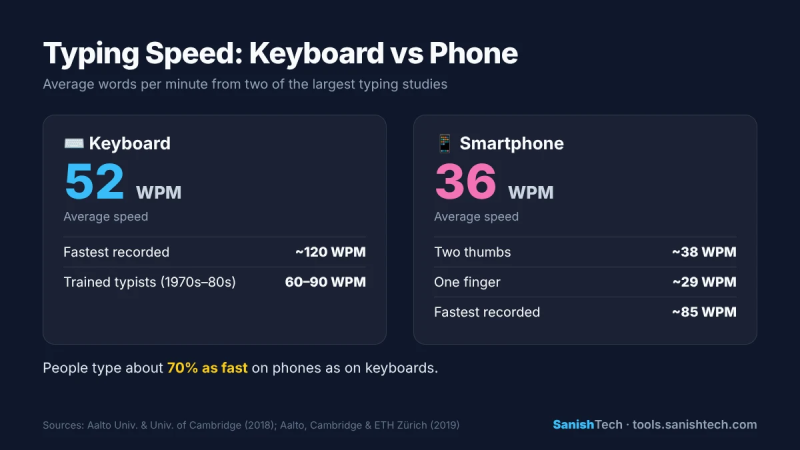
A follow-up study by Aalto University, the University of Cambridge and ETH Zürich tested more than 37,000 volunteers from over 160 countries on smartphones. The results:
| Keyboard | Smartphone | |
|---|---|---|
| Average speed | ~52 WPM | ~36 WPM |
| Two thumbs | — | ~38 WPM |
| One finger | — | ~29 WPM |
| Fastest recorded | ~120 WPM | ~85 WPM |
People typed about 70% as fast on phones as on keyboards. Typing with two thumbs was the single biggest speed boost, and autocorrect helped more than tapping word suggestions.
Average typing speed by age
The smartphone study found a clear age gap:
| Age group | Average phone typing speed |
|---|---|
| 10–19 | ~40 WPM |
| 40–49 | ~29 WPM |
| 50–59 | ~26 WPM |
Younger users have grown up on touchscreens, so their thumbs are faster. On physical keyboards, age matters less than practice — a 45-year-old who touch types will usually beat a 20-year-old who hunts and pecks.
Net WPM vs gross WPM: which number is your real speed?
When you take a typing test, you’ll usually see two speeds:
- Gross (raw) WPM: everything you typed, divided by time. One “word” = 5 characters, including spaces.
- Net WPM: gross WPM minus your errors. This is your real speed and the number employers and exams use.
Our typing test shows both, plus accuracy and a consistency score (0–100%) that tells you how steady your speed was across the test.
What makes some people type faster?
The Aalto study found a few clear differences between fast and slow typists:
- Fewer errors. Fast typists don’t just move quicker — they make fewer mistakes, so they waste less time correcting.
- Rollover typing. The fastest typists press the next key before releasing the previous one on 40–70% of keystrokes.
- Eyes on the screen. Not looking at the keyboard lets you spot mistakes instantly.
- Using more fingers. Self-taught typists can be fast, but spreading the work across all fingers helps most people go further.
How to increase your typing speed
- Take a baseline test. Note your net WPM, accuracy and weakest keys.
- Fix technique before chasing speed. Learn the home row (A S D F / J K L 😉 and stop looking down.
- Practise 15–30 minutes a day. Short daily sessions beat one long weekly session.
- Drill your weak keys. Our test shows a keyboard map of the keys you miss most — practise those specifically.
- Slow down to speed up. Aim for 95%+ accuracy first. Speed follows.
- Use structured lessons. The tool includes 12 free touch-typing lessons with a finger guide.
- Re-test weekly and track your progress.
Most beginners can add 10–20 WPM in 4–6 weeks of consistent practice.
Prove your typing speed with a verified certificate
A screenshot of a typing test proves nothing — anyone can edit one. If you need to show your speed to an employer or client, our verified typing certificate is built to be checked:
- Shows your name, net WPM, accuracy, test details and date
- Has a unique ID and QR code linking to a public verification page
- Score is calculated on the server from your recorded keystrokes, with pasting and scripts detected
- US$2 (₹99 in India) per certificate, no subscription
Add the verification link to your resume, LinkedIn or freelance profile.
Frequently asked questions
What is the average typing speed?
About 52 WPM on a computer keyboard and about 36 WPM on a smartphone, based on large studies by Aalto University and the University of Cambridge. Most people fall between 35 and 65 WPM.
Is 40 WPM a good typing speed?
Yes. 40 WPM is a solid, average speed that’s enough for most office jobs, especially with 95%+ accuracy.
Is 60 WPM fast?
Yes. 60 WPM is faster than most people and is in the professional range typical of trained typists.
Is 100 WPM a good typing speed?
100 WPM is exceptional. Only a small share of typists reach it, and it’s usually the result of years of touch typing.
What is the fastest typing speed ever recorded?
Competitive typists have recorded bursts well above 200 WPM on short tests. In the Aalto study’s controlled test with random sentences, the fastest participants reached about 120 WPM.
How long does it take to improve typing speed?
With 15–30 minutes of daily practice, most people improve 10–20 WPM within 4–6 weeks. Beginners usually improve fastest.
What is a good typing speed for a 12-year-old?
There’s no official standard. Many schools treat 20–30 WPM on a keyboard as a reasonable goal for that age, rising as students practise touch typing.
How is WPM calculated?
One word is counted as 5 characters, including spaces. Gross WPM = total characters ÷ 5 ÷ minutes. Net WPM subtracts errors from that.
Test your typing speed now
You’ve seen the averages — now find out your number. The test is free, takes as little as 15 seconds, and works on desktop or phone.
Start the free typing speed test →
Related reading: How to Increase Typing Speed: 12 Drills That Actually Work (2026) · Net WPM vs Gross WPM vs Accuracy · Online Typing Certificate 2026: Which Ones Employers Can Actually Verify · Touch Typing for Beginners 2026
Sources: Dhakal, Feit, Kristensson & Oulasvirta, Observations on Typing from 136 Million Keystrokes, CHI 2018 (Aalto University / University of Cambridge) · Aalto University, University of Cambridge & ETH Zürich mobile typing study (2019)