

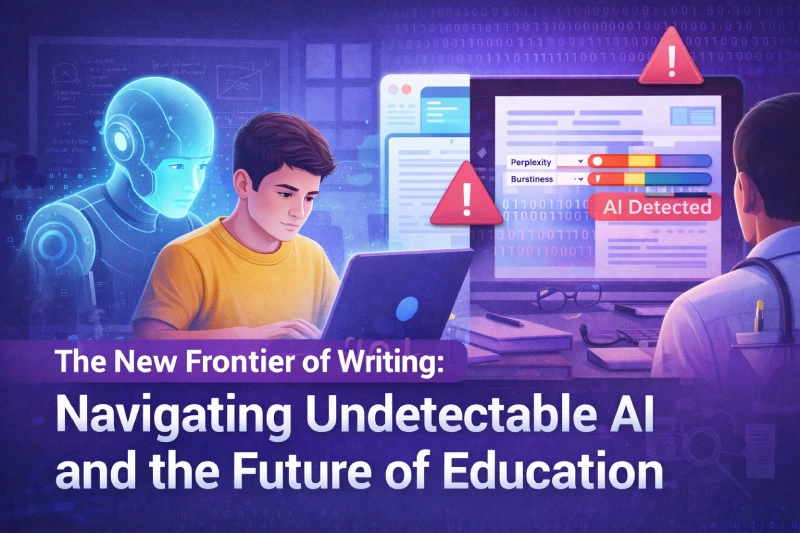
In the last few years, the landscape of the classroom has changed more than it did in the previous century. We’ve moved from “don’t use Wikipedia” to “is this entire essay written by a machine?” As we move through 2026, the conversation has shifted. It’s no longer just about whether students use Artificial Intelligence; it’s about how that AI presents itself.
Terms like Undetectable AI and Bypass AI have become staples in the vocabulary of students and educators alike. But what do they actually mean, and how are they reshaping the way we teach, learn, and write?
What is Undetectable AI?
At its core, Undetectable AI refers to AI-generated content that has been refined, structured, or “humanized” to a point where it can no longer be identified as machine-made by common detection tools.
Early AI models (like the original GPT-3) had a very specific “thumbprint.” They were overly polite, used repetitive sentence structures, and lacked the “burstiness” (the variation in sentence length and complexity) that defines human writing. Today’s sophisticated tools, however, can mimic the nuances of human thought, including subtle shifts in tone and occasional (intentional) stylistic imperfections.
Why the Need to “Bypass AI” Detectors?
You might wonder: If a student is using AI ethically, why would they need to bypass a detector? The reality is more complex than a simple “cheat or don’t cheat” binary. Here are the primary reasons:
- False Positives: Many AI detectors, including those integrated into platforms like Turnitin, have been known to flag non-native English speakers or students with very formal writing styles as “AI-generated.”
- Creative Collaboration: Many students use AI as a brainstorming partner. If they use AI to outline and then write the content themselves, some detectors might still flag the structural logic as “robotic.”
- Privacy Concerns: Some writers prefer to keep their creative process private and don’t want their work scrutinized by algorithmic “truth-checkers” that can be wrong.
How Does Bypass AI Technology Work?
To understand how to Bypass AI detection, we first have to understand how detectors work. Most detectors look for two key metrics: Perplexity and Burstiness.
- Perplexity: This measures the randomness of the text. If a word is highly predictable based on the previous word, perplexity is low (likely AI).
- Burstiness: This measures the variation in sentence structure. AI tends to be consistent, while humans write in “bursts”—a long, flowing sentence followed by a short, punchy one.
Undetectable AI tools work by re-processing AI text to inject high perplexity and varied burstiness. They replace “overused” AI transition words (like “Furthermore” or “In conclusion”) with more natural, conversational alternatives.
| Feature | Standard AI Output | Undetectable AI / Humanized |
| Sentence Length | Uniform and consistent | High variation (Short & Long) |
| Vocabulary | Predictive and “safe” | Dynamic and contextual |
| Tone | Neutral and clinical | Personable and opinionated |
| Logic Flow | Perfectly linear | Non-linear, includes anecdotes |
For Students: Using AI as a Tool, Not a Crutch
If you are a student in 2026, the temptation to use a “Bypass AI” tool to turn in an essay in seconds is real. However, the goal of education isn’t just to produce a document; it’s to build your brain.
1. The “Human-in-the-Loop” Method
Instead of asking an AI to “write 1000 words on Shakespeare,” try this:
- Ask the AI for a unique perspective on Hamlet.
- Write your own draft based on that perspective.
- Use AI to check for grammatical errors or to suggest a stronger opening.
- By the time you’re done, the writing is truly yours, and it will naturally be Undetectable AI because it originated from your own logic.
2. Don’t Fear the Detector, Respect the Process
If you use AI for research, keep a log of your prompts and the AI’s responses. If a teacher flags your work, you can show your “work history.” Transparency is the best way to bypass the negative stigma of AI.
For Teachers: Evaluating Writing in the Age of AI
The rise of Bypass AI technology means that “catching” AI is becoming a losing battle. If a student uses a high-quality Undetectable AI tool, the likelihood of a software-based detector catching it with 100% certainty is slim.
So, how should educators respond?
1. Shift from “Product” to “Process”
Instead of grading only the final essay, teachers are now focusing on the journey:
- In-class drafting: Have students write sections of their essays by hand or on monitored devices during class.
- Oral Defenses: A quick five-minute chat with a student about their paper will immediately reveal if they understand the content or if a machine wrote it for them.
- Version History: Asking students to submit their Google Docs or Word files with “Track Changes” or version history enabled.
2. Emphasize Personal Voice
AI is great at facts, but it’s terrible at having a personal life. Teachers can craft prompts that require:
- Personal anecdotes.
- Connections to specific classroom discussions that aren’t on the public internet.
- Local community references.
The Teacher’s Golden Rule: If a prompt can be answered perfectly by a machine, it might be time to change the prompt.
The Ethical Middle Ground: The “Co-Pilot” Era
The emergence of Undetectable AI doesn’t have to be a threat to academic integrity. In the professional world—whether you are a marketer, a coder, or a journalist—using AI to enhance your workflow is seen as a skill, not a “cheat.”
We are entering the “Co-Pilot” era of writing. The most successful writers will be those who can leverage Bypass AI techniques not to hide their tracks, but to ensure their AI-assisted work feels authentic, empathetic, and engaging to a human audience.
The Dangers of Over-Reliance
While Bypass AI tools can help your text sound more human, they cannot check for “Hallucinations.” AI often makes up facts, citations, and dates. If you use an undetectable tool but the facts are wrong, you will still fail the assignment (and lose your credibility).
Conclusion: Adapting to the New Normal
Whether we like it or not, Undetectable AI is here to stay. For students, these tools offer a way to protect their work from faulty detectors and refine their digital voice. For teachers, they represent a challenge to evolve teaching methods beyond the standard essay.
The future of writing isn’t “Man vs. Machine.” It’s “Man + Machine.” By understanding how to use these tools ethically and transparently, we can move past the fear of detection and get back to what really matters: the exchange of ideas.