

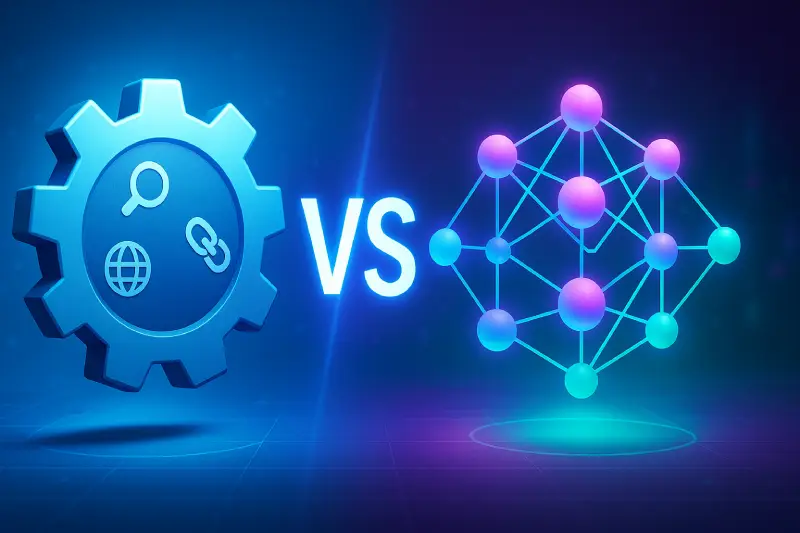
For nearly two decades, dominating Google was the clearest path to online visibility. Rank at the top of search results, earn the click, convert the visitor. SEO was the game — and everyone learned its rules.
In 2026, a second game has started. It is called GEO — Generative Engine Optimization — and it is being played on a completely different board. Instead of ranking in a list of ten blue links, you are competing to be referenced inside AI-generated answers from ChatGPT, Google Gemini, and Claude. These tools do not show a results page. They generate a response. They choose their sources. And they decide whether your content makes the cut.
This guide breaks down SEO vs GEO in plain English — what each one is, how they differ, how they work together, and exactly how to optimize for both in 2026.
⚡ Quick Answer: SEO vs GEO
SEO (Search Engine Optimization) helps your content rank in Google, Bing, and Yahoo search results. GEO (Generative Engine Optimization) helps your content get cited inside AI-generated answers from ChatGPT, Gemini, and Claude. SEO optimizes for clicks; GEO optimizes for mentions. In 2026, a complete content strategy requires both.
What is SEO? Search Engine Optimization Explained
SEO is the practice of optimizing your website so it appears in search engine results when users search for relevant topics. Think of your website as a digital billboard — but one that only shows up on the right highway if you follow the rules set by search engine algorithms.
Search engines crawl the internet continuously, index every page they find, and rank those pages based on relevance, authority, and technical quality. When someone types a query, the engine surfaces the most relevant results. SEO is the work you do to ensure your pages are among them.
The Core Elements of SEO
Keywords — Identifying the exact phrases your audience searches for and incorporating them naturally into your content. Not just “email marketing” but “how to write email marketing campaigns that convert.”
On-Page Optimization — Title tags, meta descriptions, heading structure, internal links, and image alt text all communicate what your page is about to search engine crawlers.
Technical SEO — Page speed, mobile responsiveness, HTTPS security, crawlability, and Core Web Vitals. If search engines struggle to access your content, rankings suffer regardless of quality.
Backlinks — Links from other authoritative websites act as votes of confidence. They signal to search engines that your content is worth citing.
Content Quality and E-E-A-T — Google evaluates Experience, Expertise, Authoritativeness, and Trustworthiness. Content that demonstrates genuine knowledge from credible sources consistently outperforms thin or generic writing.
Strengths of SEO
SEO drives sustainable organic traffic — pages that rank well can deliver visitors for months or years without ongoing ad spend. It reaches a high-intent audience — people actively searching for what you offer are far closer to conversion than passive audiences. Strong rankings also build brand authority by signalling credibility to every visitor.
Limitations of SEO in 2026
SEO takes time. New content often requires three to six months to earn meaningful rankings. The space is increasingly competitive, with large publishers and AI-generated content mills crowding the top positions. Algorithm updates can shift rankings dramatically overnight. And critically — for a growing proportion of queries, users are no longer opening Google at all. They are asking an AI.
What is GEO? Generative Engine Optimization Explained
GEO — Generative Engine Optimization — is the emerging discipline of optimizing your content to appear inside AI-generated responses from tools like ChatGPT, Google Gemini, Perplexity, and Claude. These platforms do not return a list of links. They synthesize a direct answer — and they select which sources to draw from, reference, or quote.
In SEO, the goal is to rank. In GEO, the goal is to be referenced.
The shift matters because user behavior is changing measurably. A significant and growing percentage of informational queries now go directly to AI tools rather than search engines. If your content is absent from AI-generated answers, you are invisible to that audience entirely — regardless of how well you rank on Google.
The Core Elements of GEO
Citation-Worthy Content — AI models are trained on high-quality sources and reward clarity, factual accuracy, and quotable structure. Short, precise claims backed by data are far more likely to be incorporated into AI responses than vague, general writing.
Entity Optimization — Consistently mentioning your brand name, author credentials, product names, and relevant facts across the web helps language models assess your credibility and associate your entity with specific topics.
Factual Authority and E-E-A-T Signals — AI systems, like Google, prioritize reliable sources. Expert insights, cited references, and clear contextual framing increase the probability of your content being selected as a source.
Prompt Compatibility — AI users phrase queries as full natural language questions, not keyword fragments. Your content needs to directly answer questions like “What is the difference between SEO and GEO?” — ideally in a dedicated, clearly labeled section.
Structured Formatting — FAQs, tables, bullet points, and well-organized headings are highly extractable by AI models. They allow the model to lift and synthesize your content efficiently.
How to Track GEO Performance
Unlike SEO, there is no universal dashboard for GEO metrics yet. In 2026, the most practical approaches are manually testing prompts in ChatGPT, Gemini, and Claude to see whether your content is referenced; using tools like SEO.ai’s GEO tracker and AlsoAsked for prompt trend monitoring; and tracking brand mentions and paraphrased versions of your content appearing in AI-generated responses.
Ignoring GEO in 2026 is comparable to ignoring SEO in 2005. The window for early mover advantage is open now.
SEO vs GEO: Direct Comparison
On the surface, SEO and GEO sound like two sides of the same coin. In practice, they are playing entirely different games — and winning at one does not automatically mean winning at the other.
| Feature | SEO | GEO |
|---|---|---|
| Target Platform | Google, Bing, Yahoo | ChatGPT, Gemini, Claude, Perplexity |
| Ranking Goal | Appear in top 10 search results | Be cited or referenced in AI-generated answers |
| User Intent | Keyword-based search queries | Natural language prompts and questions |
| Optimization Focus | Keywords, metadata, backlinks, on-page elements | Clarity, factual accuracy, structured formatting, entity authority |
| Citation Signals | Backlinks from other websites | Brand mentions, consistent entity presence, fact-based content |
| Time to Visibility | Weeks to months | Can be immediate once indexed by LLMs |
| Content Format | Blogs, landing pages, guides | Data-rich, FAQ-structured, citable answers |
| Primary Tools | Ahrefs, Semrush, Rank Math, Google Search Console | SEO.ai, manual AI prompt testing, brand mention tracking |
| Best For | Driving organic website traffic | AI presence, brand authority, next-gen discoverability |
The Key Content Difference
SEO content is structured for search engine crawlers — keyword placement, heading hierarchy, internal links, and metadata signal relevance to an algorithm that returns a ranked list.
GEO content is structured for generative AI models — clean formatting, modular sections, direct answers to specific questions, and factual precision signal reliability to a model that synthesizes a single response.
The analogy: SEO is writing for a librarian who catalogs your book on a shelf. GEO is writing for a professor who might quote your work in a lecture.
Can SEO and GEO Work Together?
Absolutely — and in 2026, the most effective content strategies treat them as complementary layers of the same system rather than competing approaches.
SEO gets your content found and clicked through traditional search. GEO gets your brand mentioned and quoted inside AI-generated conversations. A user might find your site through Google, then later ask ChatGPT a related question — and recognize your brand when it appears in the AI’s response. That dual presence compounds authority and trust in a way that neither channel achieves alone.
How to Build a Combined SEO + GEO Strategy
Write for humans first, then optimize for both engines. Content that is genuinely useful, clearly written, and well-organized satisfies both an SEO crawler and an AI model simultaneously. Quality is the common foundation.
Use structured data (schema markup) throughout. Schema helps both Google’s bots and AI engines understand the context, structure, and claims within your content. FAQ schema, Article schema, and HowTo schema are particularly valuable.
Include FAQ and Q&A sections on every major page. These are among the most extractable formats for both featured snippets in Google and direct citations in AI responses. A well-written FAQ serves both channels simultaneously.
Maintain accuracy and cite original sources. Source attribution strengthens E-E-A-T for SEO and signals factual reliability to AI models evaluating whether to reference your content.
Use logical heading hierarchies. Search engines use headings for crawlability and indexing. AI models use headings to extract and synthesize key ideas. Clear H2 and H3 structure serves both audiences.
Real-World Example
Suppose you run a digital marketing blog. Your SEO-optimized article on email marketing ranks on Google’s first page for “what is email marketing.” That same article — because it includes clear definitions, cited statistics, and a well-structured FAQ — gets referenced by ChatGPT when a user asks “How does email marketing work?”
The result: you are visible in both the search-driven web and the AI-powered conversational interface. Neither piece of work was duplicated. The same content, structured correctly, earned presence in both channels.
How to Optimize for GEO in 2026
If your SEO foundations are in place, you are closer to GEO-readiness than you might think. The mindset shift is this: you are no longer writing to rank a page — you are writing to become a source that AI models find credible enough to cite.
1. Create Factual, Citable Content
Include specific statistics, data points, definitions, and original insights rather than general statements. Clearly attribute external sources when referencing research. Use short, precise, quotable sentences — these are the chunks AI models lift most readily.
Instead of: “There are many tools available for tracking AI citations” Write: “SEO.ai and AlsoAsked are the most widely used tools for monitoring AI-generated citation trends in 2026.”
2. Format for AI Extractability
Structure content in modular, self-contained sections. Use bullet points, comparison tables, and clear subheadings. Answer specific questions directly and completely within a single section — AI models prefer tightly scoped knowledge blocks over sprawling narrative.
3. Apply Schema Markup Consistently
Implement FAQ schema, Article schema, HowTo schema, and Q&A formats wherever applicable. Schema helps both Google and AI engines understand your page’s structure and purpose, increasing the probability of selection as a featured snippet or AI source.
4. Build Consistent Entity Presence
Ensure your brand name, author credentials, and topical associations are consistent and frequently referenced across your website, social profiles, and third-party publications. AI language models use entity consistency to assess credibility — an author with a clear, coherent web presence is more trustworthy than an anonymous one.
5. Optimize for Prompt-Like Queries
AI users ask full questions, not keyword fragments. Include natural question-and-answer structures in your content that mirror how users prompt AI tools. Questions like “What is the difference between SEO and GEO?” or “Which is better for a new website — SEO or GEO?” should be answered directly and clearly within the relevant section.
6. Monitor and Iterate
Test your most important pages by prompting ChatGPT, Gemini, and Claude with the questions those pages address. Note whether your brand or content is referenced. Double down on the formats and sections that get cited. Repurpose content that earns AI mentions into additional formats to reinforce entity presence.
Is GEO Replacing SEO? The Future of Content Ranking
This is the central question — and the short answer is no. But the longer answer requires nuance.
SEO is not dying. It is shifting. Google still processes billions of searches daily, and organic search traffic remains a primary channel for most websites. What is changing is the proportion of queries that bypass traditional search entirely in favor of AI-generated answers. That proportion is growing — and the content that serves it must be optimized differently.
The Rise of AI-Integrated Search
Google’s AI Overviews (formerly SGE) now blend AI-generated summaries with traditional search results on an increasing range of queries. Microsoft Copilot surfaces ChatGPT-style answers before presenting Bing results. Perplexity has built an entire search product around AI synthesis. Even platforms like Reddit, YouTube, and Amazon are testing generative layers within their own search experiences.
The direction is clear: AI-integrated search is becoming the default interface for information retrieval. Content that is not structured for AI extraction is at risk of being bypassed — even when it ranks well in traditional search.
What Changes for Content Creators
The shift from keyword optimization to genuine explanation becomes more pronounced. First-position rankings matter less than being a reliable, citable source across multiple platforms. Demand for structured, fact-checked, expert-attributed writing grows. Entity-based optimization — establishing who you are, not just what you write about — becomes a primary visibility signal.
What Stays the Same
Human value is irreplaceable. AI rewards content that genuinely solves problems — the same content quality signals that matter for SEO matter for GEO. Brand authority compounds over time in both environments. And clarity — writing that any reader can understand quickly and trust — consistently outperforms complexity regardless of which engine processes it.
GEO is not a passing trend. It is a structural shift in how information is discovered online. Those who adapt their content strategy now will hold significantly more digital real estate in 2028 and beyond than those who wait.
Actionable Takeaways: Winning at Both SEO and GEO
- Keep building quality backlinks and targeting keywords — traditional SEO signals remain foundational
- Audit your top-performing pages and restructure them into citable, modular blocks that AI can extract cleanly
- Add FAQ and HowTo schema to every major page — these formats serve both Google featured snippets and AI citations simultaneously
- Include statistics, definitions, and clearly attributed facts in every key section — specificity is the currency of GEO
- Test your content in AI tools — prompt ChatGPT, Gemini, and Claude with the questions your pages address and note what gets cited
- Build consistent entity presence — your author bio, brand name, and topical authority signals should be coherent and verifiable across the web
- Think like a human, write like an expert, structure like a machine — this single principle covers both SEO and GEO simultaneously
“In the past, we optimized for bots to get clicks. Today, we optimize for brains — both human and artificial — to be remembered.”
Frequently Asked Questions: SEO vs GEO
Is GEO the end of traditional SEO?
No. GEO does not replace SEO — it expands the playing field. SEO remains essential for driving organic traffic from Google and Bing, which collectively still handle the majority of web searches in 2026. GEO adds a second visibility layer by making your content citable inside AI-generated answers from ChatGPT, Gemini, and Claude. A complete content strategy in 2026 requires both.
Can the same content rank in Google and be cited by AI tools?
Yes — and this is the goal. Content that is well-structured, factually accurate, and clearly written serves both channels simultaneously. The key is formatting: keyword-optimized for SEO, and structured in modular, answer-ready sections for GEO. FAQ blocks, comparison tables, and direct question-answer pairs perform well in both environments.
What type of content do ChatGPT and Gemini cite most often?
AI models consistently favor content that is factual and data-backed, clearly structured with headings, bullet points, or tables, written in a direct and authoritative tone without promotional language, and published by sources with consistent entity presence across the web. Thin, vague, or heavily promotional content is rarely cited regardless of its search ranking.
Do backlinks help with GEO?
Indirectly, yes. Backlinks do not function for AI tools the way they do for search engines — AI models do not follow link graphs directly. However, backlinks build broader brand authority and increase the number of web sources that reference your entity, both of which influence how language models assess your credibility. A site with strong backlink authority is more likely to be treated as a reliable source by AI systems.
How can I track whether AI tools are citing my content?
No universal GEO analytics dashboard exists yet in 2026, but practical tracking methods include manually testing relevant prompts in ChatGPT, Gemini, Claude, and Perplexity; using SEO.ai’s GEO tracking features and Google’s AI Overviews monitoring tools; and watching for brand mentions in analytics platforms and AI-augmented search interfaces. When you find content that gets cited, analyze its structure and replicate it across other pages.
How is GEO different from traditional SEO content writing?
Traditional SEO writing is optimized for keyword placement, metadata signals, and a crawler that indexes pages for a ranked list. GEO writing is optimized for extractability — the ability of an AI model to lift, summarize, or directly quote a specific section of your content in a synthesized response. GEO content tends to be more modular, more fact-dense, and more directly structured around answering specific questions rather than comprehensively covering a topic for reading flow.